
Climate Transition Framework Methodology Disclosure
These disclosures are published by Allspring Global Investments (Allspring) in accordance with Annex III of the ESG Ratings Regulation (Regulation (EU) 2024/3005). They apply where Allspring Global Investments (Luxembourg) S.A., as an EU regulated financial undertaking, refers to proprietary ESG ratings or internal ESG assessment methodologies in its marketing communications, within the meaning of Article 2(2)(c) of the ESG Ratings Regulation.
The disclosures are intended to provide an overview of the proprietary ESG ratings and related assessment tools applied by Allspring and to support transparency for our clients.
These disclosures relate solely to the Climate Transition Framework (the “Framework”), an internally developed ESG score and qualitative assessments system used by Allspring for investment analysis, portfolio management and related external communications. They do not constitute independent or third party ESG scores, investment advice or a recommendation, nor do they represent a determination that any investment, strategy or product achieves a particular ESG objective or standard. The methodologies underlying Allspring’s proprietary ESG score rely on a combination of third-party data sources, internal analysis and professional judgement, and are subject to change, inherent limitations, data availability constraints and ongoing methodological development.
Rating Product Disclosures
The Climate Transition Framework is Allspring’s proprietary qualitative analytical system to assess how climate change affects company fundamentals and how companies contribute to or are positioned for decarbonization. It is applicable only to corporate bond issuers.
Objective and financial materiality approach
Objective
The objective of the Framework is to assess climate transition–related financial risks and opportunities at the issuer level. The Framework considers company business model, technology, physical, regulatory, and other climate risks and opportunities by mapping the implications of these drivers to company strategy and governance, asset and operating position, financial profile, and macroeconomic position. The Framework seeks to assess whether companies are or may benefit from decarbonization as well as how the company may be affected by climate risks.
Materiality
- The Framework applies single materiality, focused on how climate change and decarbonization pathways may affect company fundamentals, valuation, and long-term financial resilience.
- The Framework does not assess a company’s impact on the environment or society.
Scope of ESG factors covered
The Framework is an aggregated score, covering four ESG factors known as pillars, that are comprised of 14 topics:
| PILLAR | QUALITATIVE SCORING CRITERIA |
|
Strategy & governance |
Thoroughness & rigor of overall climate strategy |
|
Asset & operating position |
Competitiveness of Scopes 1 and 2 – company operations |
|
Financial profile |
Climate liabilities |
|
Macroeconomic position |
Exposure to climate-driven macroeconomic risk |
To generate the score, analysts evaluate each company on pillar-specific criteria which are equally aggregated to generate pillar level scores. Pillar scores in turn are used to generate a final overall score following the weighting rubric below. Along with the final score, analysts may assign a trend indicator that is positive or negative, otherwise the trend is considered neutral. The trend reflects the direction of travel and allows for a degree of subjectivity that is helpful for identifying climate leaders.
Weighting of E, S and G factors
To compute the final Climate Transition Framework score, the pillars are weighted as follows:
- Strategy & governance: 40%
- Asset & operating position: 35%
- Financial profile: 15%
- Macroeconomic position: 10%
The E, S and G factors embedded in the Framework do not correspond to the European Sustainability Reporting Standards (ESRS).
Expression of rating
The Framework score is intended to be comparable across industries, not industry relative.
Consideration of international agreements
In applying the Framework to their scoring, analysts consider issuers’ emission reduction targets, strategies and performance relative to the objectives of the Paris Agreement. See “Rating scale” section below for further information.
The Framework does not assess formal alignment with the Paris Agreement or other international environmental, social, or governance agreements.
General Methodological Disclosures
Overview of Climate Transition Framework methodology
The Climate Transition Framework is Allspring’s proprietary analytical system to assess how climate change affects company fundamentals and how companies contribute to or are positioned for decarbonization at the corporate bond issuer level. The Framework is designed to support Allspring’s investment research, portfolio construction, and risk management processes.
The methodology considers quantitative and qualitative inputs to form the Framework score. The Framework is risk and opportunity oriented, assessing how climate-related factors may influence an issuer’s fundamental strength, positively or negatively, along with a company’s decarbonization potential.
The methodology is primarily forward looking, drawing on analyst judgment, including trend assessments and consideration of strategic developments where relevant, but also incorporates backward looking elements through historical and current climate data.
Framework scores are updated periodically based on analyst judgement and are generally considered valid until the next update. The methodology is reviewed periodically and updated as necessary to reflect improvements in data quality, analytical techniques, and other developments.
Rating scale
Framework scores are expressed on a 1 to 4 scale, where:
- 1 represents fundamental risk from climate change, and limited or no alignment with the Paris Agreement with no apparent commitment to change
- 2 represents neutral fundamental risk and climate transition awareness
- 3 represents fundamental beneficiary and targeting or moving towards Paris Agreement alignment
- 4 represents strong fundamental beneficiary, and likely Paris Agreement aligned or better
Analysts may assign “+” or “–” trend modifiers to reflect improving or declining outlook, respectively. The degree of Paris Agreement alignment is a mapping of the score to the aims of the Paris Agreement – it is not explicitly the design of the Framework.
Framework scores are intended to be interpreted as indicators of climate-related financial risk or opportunity and should not be viewed as standalone investment recommendations.
Absolute nature of ratings
The Framework scores are intended to be industry-agnostic, not relative to industry peers.
Quality measures and procedures
The information from third-party data providers may be incomplete, inaccurate, or unavailable. Third-party data may include both reported and estimated data and the proportion of estimated data changes over time depending on availability of information accessible to data providers, process changes and methodological approaches, amongst other factors.
Allspring communicates regularly with our data providers on matters related to methodologies, coverage, and quality standards, as applicable, and provides employees with guidance on the consistent, accurate, and secure handling of data across the organization. Additionally, our investment teams’ proprietary research and engagement with companies serves as an independent check on the quality and accuracy of data utilized in the process.
Industry classification
The Framework does not employ industry classification in calculating scores.
Data sources and data processing
Data sources
The Framework methodology draws on multiple sources, including but not limited to:
- Third party ESG data providers: MSCI, Morningstar Sustainalytics, Bloomberg
- Rating agency reports: Moody’s, S&P, Fitch, KBRA
- Industry data: International Energy Agency, CDP, SBTi
- Company information, including company engagements
Data is not sourced from sustainability statements required by the Sustainable Finance Disclosure Regulation, (Regulation (EU) 2019/2088)SFDR.
Data inputs include both public (i.e. freely available) and non-public (i.e. paid or information from discussions with company management) sources.
Data processing and estimation
In conducting their Framework assessments, analysts may:
- Leverage other Allspring research and recommendations which are based on fundamental research and sector expertise and using a variety of sources including market data platforms, sell-side firms, credit rating agencies, universities, non-governmental organizations, government agencies and other publicly available databases.
- Consider company management quality, including management strategies and compensation structures, as part of their fundamental assessment. This may include meetings with management teams from time to time to discuss their business, growth strategies, catalysts, incentive structures and climate transition strategies. Understanding these factors helps inform views on management decision making and potential actions, which may inform their Framework assessments and trend (“+” or “-“) assignment, but does not guarantee changes to scores.
As a fundamental analyst-driven research process, the Framework employs but does not rely on data. Data is not estimated in cases of unavailability.
Framework scores are updated periodically subject to analyst judgement.
Scientific basis of the methodology
The Framework and Climate Transition Framework scoring is not based on a scientific evidence process.
Use of artificial intelligence and automation
The methodology does not rely on artificial intelligence systems. Human judgment from industry analysts is central to the qualitative assessment and to the interpretation of results.
Limitation in data sources, methodologies and information
Methodological and data limitations
Key limitations of the Framework include:
- Variability in quality, completeness, and consistency of company climate data
- Reliance on third-party data methodologies that may change over time
- Time lags between company activities and reported data
- Forward-looking assumptions that may not fully capture future policy, technology, or market developments
These limitations mean Framework scores should be interpreted as indicative assessments, not precise measurements.
Refer to “Data sources and data processing” above for information on timeliness of Climate Transition scores and “Overview of Climate Transition Framework methodology” above for potential limitations on the information available to third-party rating providers .
Organizational disclosures
Ownership structure
The Framework is developed and maintained internally by Allspring Global Investments.
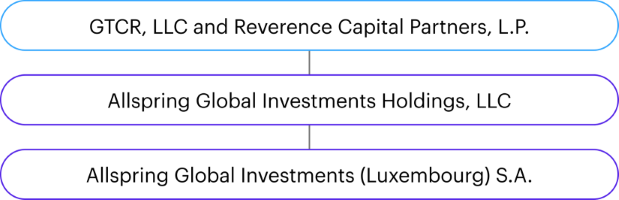
Set out below is a chart illustrating the primary ownership structure of Allspring Global Investments (Luxembourg) S.A.:
Fees and business model
Framework scores are produced internally by Allspring and are not sold or licensed to clients or third parties. No separate fees are charged for Framework scores.
Conflicts of interest
The Framework is developed within Allspring’s investment organization. Potential conflicts of interest are managed and mitigated, where possible, through governance, oversight, and control frameworks applicable to Allspring’s research and investment activities
Important Information
Allspring Global InvestmentsTM (Allspring) is the trade name for the asset management firms of Allspring Global Investments Holdings, LLC, a holding company indirectly owned by certain private funds of GTCR LLC and Reverence Capital Partners, L.P. These firms include but are not limited to Allspring Global Investments Luxembourg, S.A.; Allspring Funds Management, LLC; Allspring Global Investments, LLC; Allspring Global Investments (UK) Ltd.; Allspring Global Investments (Singapore) Pte. Ltd.; Allspring Global Investments (Hong Kong) Ltd.; and Allspring Global Investments (Japan) Ltd.
Unless otherwise stated, Allspring is the source of all data (which is current or as of the date stated). Content is provided for informational purposes only. Views, opinions, assumptions, or estimates are not necessarily those of Allspring or their affiliates and there is no representation regarding their adequacy, accuracy, or completeness. They should not be relied upon and may be subject to change without notice. Any benchmark referenced is for comparison purposes only, unless specified.