
ESGiQ Methodology Disclosure
These disclosures are published by Allspring Global Investments (Allspring) in accordance with Annex III of the ESG Ratings Regulation (Regulation (EU) 2024/3005). They apply where Allspring Global Investments (Luxembourg) S.A., as an EU regulated financial undertaking, refers to proprietary ESG ratings or internal ESG assessment methodologies in its marketing communications, within the meaning of Article 2(2)(c) of the ESG Ratings Regulation.
The disclosures are intended to provide an overview of the proprietary ESG ratings and related assessment tools applied by Allspring and to support transparency for our clients.
These disclosures relate solely to ESGiQ® (ESG Information Quotient), an internally developed ESG rating and qualitative assessment framework used by Allspring for investment analysis, portfolio management and related external communications. They do not constitute independent or third party ESG ratings, investment advice or a recommendation, nor do they represent a determination that any investment, strategy or product achieves a particular ESG objective or standard. The methodologies underlying Allspring’s proprietary ESG rating rely on a combination of third party data sources, internal analysis and professional judgement, and are subject to change, inherent limitations, data availability constraints and ongoing methodological development.
Rating Product Disclosures
ESGiQ is Allspring’s proprietary framework for assessing financially material environmental, social, and governance (ESG) risks of corporate issuers, including public and private companies, across multiple sectors and geographies where sufficient data is available.
Objective and financial materiality approach
Objective
The objective of ESGiQ is to assess industry-relative ESG related business risks that could manifest into financial risk. Companies that do not effectively manage material ESG risk exposures may face greater regulatory penalties, operational disruptions, or reputational harm—potentially weighing on consumer sentiment, revenues, expenses and cash flows, cost of capital, and ultimately security valuations. ESGiQ helps us to evaluate whether we can expect to be adequately compensated for ESG risks.
Materiality
- ESGiQ applies single materiality, focused on the financial implications of industry-specific ESG factors for the company.
- ESG factors are evaluated based on their potential to influence creditworthiness, risk profiles, and long term business resilience.
- The framework does not assess a company’s impact on the environment or society.
Scope of ESG factors covered
ESGiQ is an aggregated ESG rating, covering:
- Environmental factors
- Social factors
- Governance factors
The specific ESG topics within each factor that are assessed vary by industry and are selected based on financial materiality, drawing on the Sustainability Accounting Standards Board (SASB) Standards as a reference point.
Governance considerations—particularly Management and Oversight within the qualitative component of ESGiQ—are emphasized due to their role in shaping how other ESG risks are identified, managed, and mitigated.
Weighting of E, S and G factors
Qualitative component
Governance (Management and Oversight) is consistently weighted at 40% across all industries.
The remaining 60% reflects Environmental and Social factors, with weights that:
- Are not uniform,
- Vary by industry,
- Reflect the financial materiality of specific environmental and social topics to the issuer’s industry.
The selection and weighting of environmental and social topics are informed by the SASB Standards, ensuring that emphasis is placed on issues most likely to affect financial performance.
Quantitative components
The ESGiQ quantitative score does not weight individual E, S and G factors. The principal component analysis is run over all ESG vendor data, as well as vendor defined E, S and G data, yielding four outputs per corporate issuer.
Overall ESGiQ rating
The overall ESGiQ rating reflects a combination of:
- The quantitative score, and
- The qualitative score.
The relative influence of each component score depends on the analyst’s level of conviction in the qualitative assessment. The qualitative score drives the overall rating when the analyst has high conviction, whereas the quantitative score drives the overall rating when analyst conviction is low.
Some companies may only have a quantitative score if they are not covered by an analyst, while other companies may only have a qualitative score if they are not covered by vendors.
The E, S and G factors embedded with ESGiQ do not correspond to the European Sustainability Reporting Standards (ESRS).
Expression of rating
ESGiQ ratings are industry relative, not absolute. See the “Relative nature of ratings” section below for further information.
Consideration of international agreements
Where relevant, ESGiQ analysts may consider the targets and objectives of the Paris Agreement to the extent that they influence a company’s environmental related financial risk profile.
ESGiQ does not assess formal alignment with the Paris Agreement or other international environmental, social, or governance agreements.
General Methodological Disclosures
Overview of ESGiQ methodology
ESGiQ® (ESG Information Quotient) is Allspring’s proprietary framework for assessing financially material environmental, social, and governance (ESG) risks at the corporate issuer level. ESGiQ is designed to support Allspring’s investment research, portfolio construction, and risk management processes.
The ESGiQ methodology combines quantitative and qualitative inputs to form an overall ESG rating. The framework is risk oriented, assessing how ESG factors may influence an issuer’s long term financial performance, rather than measuring real world sustainability impacts.
The methodology is primarily backward looking, drawing on historical and current ESG data, but incorporates forward looking elements through analyst judgment, including trend assessments and consideration of strategic developments where relevant.
ESGiQ ratings are updated on a regular basis and are generally considered valid until the next update or until a material event warrants reassessment. The methodology is reviewed periodically and updated as necessary to reflect improvements in data quality, analytical techniques, and other developments.
Rating scale
ESGiQ ratings are expressed on a 1 to 5 scale, where:
- 1 represents relatively higher ESG related financial risk versus industry peers
- 5 represents relatively lower ESG related financial risk versus industry peers
Analysts may assign “+” or “–” trend modifiers to reflect improving or declining outlook, respectively.
Relative nature of ratings
- ESGiQ ratings are industry relative, not absolute.
- Companies are assessed and then ratings are assigned relative to industry constituents, allowing for meaningful comparison among companies with similar business models and risk exposures.
- A higher ESGiQ rating does not imply that a company is sustainable in absolute terms, nor does it indicate positive environmental or social impact.
ESGiQ ratings are intended to be interpreted as comparative indicators of ESG related financial risk and should not be viewed as standalone investment recommendations.
Quality measures and procedures
The information from third-party data providers may be incomplete, inaccurate, or unavailable. Third-party data may include both reported and estimated data and the proportion of estimated data changes over time depending on availability of information accessible to data providers, process changes and methodological approaches, amongst other factors.
Allspring communicates regularly with our data providers on matters related to methodologies, coverage, and quality standards, as applicable, and provides employees with guidance on the consistent, accurate, and secure handling of data across the organization. Additionally, our investment teams’ proprietary research and engagement with companies serves as an independent check on the quality and accuracy of data utilized in the process.
Industry classification
ESGiQ uses Bloomberg’s Fixed Income Classification System (BCLASS) at Level 4 as its primary industry classification framework. BCLASS provides a granular, issuer‑focused industry structure suitable for fixed income and cross‑asset analysis. See Bloomberg’s site for more information on BCLASS: https://data.bloomberglp.com/professional/sites/10/Classification-Data-Fact-Sheet.pdf
Allspring applies limited proprietary adjustments to the BCLASS Level 4 classification where necessary to better reflect industry‑specific risk characteristics for ESG analysis. These adjustments are applied consistently across the ESGiQ framework.
Data sources and data processing
Data sources
The ESGiQ methodology draws on multiple sources, including:
Third party ESG data providers:
- MSCI ESG Ratings.
- Morningstar Sustainalytics ESG Risk Ratings.
- SASB aligned data, created by mapping MSCI and Sustainalytics metrics and factors to the SASB Standards.
Company reported disclosures, including where incorporated by third party providers.
Analyst generated qualitative assessments, based on fundamental research and sector expertise, and using a variety of sources including market data platforms, sell-side firms, credit rating agencies, universities, non-governmental organizations, government agencies and other publicly available databases. These resources, including meetings with agencies and sell side analysts, are used to enhance our understanding of external recommendations, identify potential catalysts, and challenge internal investment theses.
Analysts also consider company management quality, including management strategies and compensation structures, as part of their fundamental assessment. This may include meetings with management teams from time to time to discuss their business, growth strategies, catalysts, and incentive structures. Understanding these factors helps inform views on management decision making and potential actions, which may inform their ESG risk assessments.
Data is not sourced from sustainability statements required by the Sustainable Finance Disclosure Regulation, (Regulation (EU) 2019/2088).
Data inputs include both public (i.e. freely available) and non-public (i.e. paid or information from discussions with company management) sources.
Data processing and estimation
- Quantitative ESG data is standardized and normalized to improve comparability across providers and industries.
- Statistical techniques are used to improve coverage and reduce noise.
- ESGiQ quantitative scores are typically updated monthly, subject to underlying data availability and quality
- Input source data is not estimated in case of unavailability, in other words, only companies with at least one underlying source will have an ESGiQ quantitative rating.
- ESGiQ qualitative ratings are updated periodically subject to analyst judgement.
Scientific basis of the methodology
The ESGiQ scoring methodology is not based on a scientific evidence process.
The ESGiQ quantitative methodology seeks to distill a consensus signal from multiple ESG data sources that often differ in scope, methodology, and coverage.
Principal Component Analysis (PCA) was selected for this purpose due to its well established advantages in:
- Reducing the dimensionality of complex datasets.
- Retaining the most important information shared across correlated inputs.
- Minimizing provider specific noise while preserving the dominant underlying signal.
By calculating PCA across a rolling 3-year period and then applying the results to standardized ESG inputs, ESGiQ aims to capture the common information across providers in a statistically robust manner. The methodology seeks to distil the best information from each data provider, with the least loss of information from any individual source. To make the score even more applicable, we apply this methodology within each industry.
The qualitative component of ESGiQ is grounded in financial materiality principles and analyst expertise, drawing on sector specific risk frameworks informed by the SASB Standards.
Use of artificial intelligence and automation
The methodology does not rely on artificial intelligence systems. Human judgment from industry analysts remains central to the qualitative assessment and to the interpretation of results.
ESGiQ quantitative employs statistical and algorithmic techniques in data processing and score construction. These techniques support consistency, scalability, and robustness in handling large datasets. As with any quantitative methodology, limitations may arise from data availability, model assumptions, and changes in issuer behavior over time.
Limitation in data sources, methodologies and information
Methodological and data limitations
Key limitations of ESGiQ include:
- Incomplete or inconsistent ESG disclosure by issuers.
- Differences in methodologies across third party data providers.
- Use of estimates within third-party data inputs to ESGiQ quantitative, or proxies where direct data is unavailable.
- Time lags between issuer activity and reported ESG data.
These limitations mean ESGiQ ratings should be interpreted as indicative, relative assessments, not precise measurements.
Refer to “Data sources and data processing” above for information on timeliness of ESGiQ ratings and “Overview of ESGiQ methodology” above for potential limitations on the information available to third-party rating providers used in ESGiQ.
Organizational disclosures
Ownership structure
ESGiQ is developed and maintained internally by Allspring Global Investments.
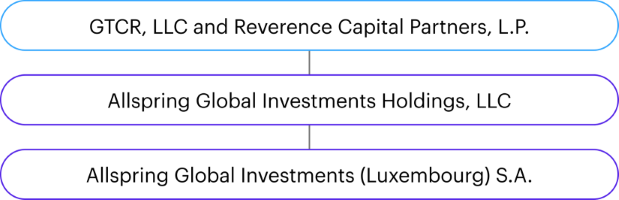
Set out below is a chart illustrating the primary ownership structure of Allspring Global Investments (Luxembourg) S.A.:
Fees and business model
ESGiQ ratings are produced internally by Allspring and are not sold or licensed to clients or third parties. No separate fees are charged for ESGiQ ratings.
Conflicts of interest
ESGiQ is developed within Allspring’s investment organization. Potential conflicts of interest are managed and mitigated, where possible, through governance, oversight, and control frameworks applicable to Allspring’s research and investment activities.
Important Information
Allspring Global InvestmentsTM (Allspring) is the trade name for the asset management firms of Allspring Global Investments Holdings, LLC, a holding company indirectly owned by certain private funds of GTCR LLC and Reverence Capital Partners, L.P. These firms include but are not limited to Allspring Global Investments Luxembourg, S.A.; Allspring Funds Management, LLC; Allspring Global Investments, LLC; Allspring Global Investments (UK) Ltd.; Allspring Global Investments (Singapore) Pte. Ltd.; Allspring Global Investments (Hong Kong) Ltd.; and Allspring Global Investments (Japan) Ltd.
Unless otherwise stated, Allspring is the source of all data (which is current or as of the date stated). Content is provided for informational purposes only. Views, opinions, assumptions, or estimates are not necessarily those of Allspring or their affiliates and there is no representation regarding their adequacy, accuracy, or completeness. They should not be relied upon and may be subject to change without notice. Any benchmark referenced is for comparison purposes only, unless specified.