
Sovereign ESGiQ Methodology Disclosure
These disclosures are published by Allspring Global Investments (Allspring) in accordance with Annex III of the ESG Ratings Regulation (Regulation (EU) 2024/3005). They apply where Allspring Global Investments (Luxembourg) S.A., as an EU regulated financial undertaking, refers to proprietary ESG ratings or internal ESG assessment methodologies in its marketing communications, within the meaning of Article 2(2)(c) of the ESG Ratings Regulation.
The disclosures are intended to provide an overview of the proprietary ESG ratings and related assessment tools applied by Allspring and to support transparency for our clients.
These disclosures relate solely to Sovereign ESGiQ® (ESG Information Quotient), an internally developed ESG rating framework used by Allspring for investment analysis, portfolio management and related external communications. They do not constitute independent or third party ESG ratings, investment advice or a recommendation, nor do they represent a determination that any investment, strategy or product achieves a particular ESG objective or standard. The methodologies underlying Allspring’s proprietary ESG rating rely on a combination of third party data sources, internal analysis and professional judgement, and are subject to change, inherent limitations, data availability constraints and ongoing methodological development.
Rating Product Disclosures
Sovereign ESGiQ is Allspring’s proprietary, quantitative framework for assessing financially material environmental, social, and governance (ESG) risks of sovereign bond issuers across developed and emerging markets globally for which sufficient data is available.
Objective and financial materiality approach
Objective
The objective of Sovereign ESGiQ is to assess financially material ESG-related risks that may influence long‑term sovereign creditworthiness. A country’s ability and willingness to repay its debt on time is dependent on strong institutions, policies, and economic development, all of which are influenced by ESG topics to different degrees. By analyzing ESG topics that contribute to institutional strength and support economic development, Sovereign ESGiQ seeks to capture relative risk of countries.
Materiality
- Sovereign ESGiQ applies single materiality, focused on the financial implications of ESG factors for countries.
- Sovereign ESGiQ does not assess a country’s impact on the environment or society.
Scope of ESG factors covered
Sovereign ESGiQ is an aggregated ESG rating, covering Environmental, Social and Governance factors known as pillars, that are composed of 19 underlying indicators, selected based on relevance to institutional quality, economic resilience, and long-term creditworthiness.
ENVIRONMENTAL |
|
|
|
Water stress |
Freedom of speech |
Government effectiveness |
|
Food security |
Demography |
Investment profile |
|
Energy use and security |
Education |
Corruption |
|
Natural capital endowment |
Socioeconomic conditions |
Law and order |
|
Waste and pollution |
Internal conflict |
Government stability |
|
Climate change vulnerability |
Access to services |
Democratic accountability |
|
|
|
Gender |
The environmental pillar is comprised of indicators regarding a country’s stewardship of its natural environment. The social pillar is comprised of indicators that describe the relationships between a country’s citizens and its power structures. The governance pillar includes indicators related to the structures or systems that manage and control a country. All countries are assessed using the same indicators.
Weighting of E, S and G factors
Indicators are equally weighted within each pillar. Pillars are weighted as follows in the overall rating:
- Environmental: 30%
- Social: 30%
- Governance: 40%
- The overweight to governance, we believe, reflects its foundational role in shaping institutional quality, policy credibility, and the effective management of environmental and social risks.
The E, S and G pillars embedded within Sovereign ESGiQ do not correspond to the European Sustainability Reporting Standards (ESRS).
Expression of rating
Sovereigns are assessed relative to other rated countries, not absolute. See the “Relative nature of ratings” section below for further information.
Consideration of international agreements
Sovereign ESGiQ does not assess formal alignment with the Paris Agreement or other international environmental, social, or governance agreements.
General Methodological Disclosures
Overview of Sovereign ESGiQ methodology
Sovereign ESGiQ is Allspring’s proprietary, quantitative framework for assessing financially material ESG risks of sovereign issuers. The framework is designed to complement traditional sovereign credit analysis by capturing longer‑term ESG-related risks that may influence a country’s institutional strength, policy effectiveness, economic development, and willingness and ability to service debt. Sovereign ESGiQ is designed to support Allspring’s investment research, portfolio construction, and risk management processes.
The methodology combines quantitative inputs to form an overall ESG rating. The rating is intended to be risk oriented, assessing how ESG factors may influence an issuer’s long-term creditworthiness, rather than measuring real world sustainability impacts. The Sovereign ESGiQ framework is applied at the country level and does not assess individual securities or currencies.
The Sovereign ESGiQ framework produces relative ESG risk ratings, enabling comparison across countries and through time. Ratings reflect relative standing versus peers, meaning that a sovereign’s rating may change even when its underlying data remains stable, as peer performance and cross‑sectional distributions evolve.
Sovereign ESGiQ is backward looking, drawing on historical and current ESG data. The ratings are updated quarterly and are generally considered valid until the next update. The underlying indicators are refreshed on varying schedules, which may result in rating changes even when country-level conditions appear unchanged.
The methodology is reviewed periodically and updated as necessary to reflect improvements in data quality, analytical techniques, and other developments.
Rating scale
All sovereigns with sufficient data coverage are assigned a rating between 1 and 10, where:
- 10 represents relatively lower ESG-related financial risk
- 1 represents relatively higher ESG-related financial risk
Relative nature of ratings
Sovereign ESGiQ ratings are relative, not absolute. A higher rating does not imply that a sovereign is sustainable in absolute terms, nor does it represent a positive real world sustainability impact. Ratings are intended to indicate relative ESG-related financial risk among sovereign peers.
Interpretation of ratings may incorporate market classification context. Developed market sovereigns are held to a higher relative standard than emerging market sovereigns when ratings are used to define sustainability characteristics of products.
Sovereign ESGiQ ratings are intended to be interpreted as comparative indicators of potential ESG related risk to sovereign creditworthiness and should not be viewed as standalone investment recommendations.
Quality measures and procedures
The information from third-party data providers may be incomplete, inaccurate, or unavailable. Third-party data may include both reported and estimated data and the proportion of estimated data changes over time depending on availability of information accessible to data providers, process changes and methodological approaches, amongst other factors.
Allspring communicates regularly with our data providers on matters related to methodologies, coverage, and quality standards, as applicable, and provides employees with guidance on the consistent, accurate, and secure handling of data across the organization. Additionally, our investment teams’ proprietary research serves as an independent check on the quality and accuracy of data utilized in the process.
Industry classification
Sovereign ESGiQ does not employ industry classification in calculating ratings.
Data sources and data processing
Data sources
The Sovereign ESGiQ methodology uses a combination of publicly available and vended datasets:
- Economist Intelligence Unit
- European Commission
- Notre Dame Global Adaptation Initiative
- PRS Group
- Reporters Without Borders
- Transparency International
- United Nations
- World Bank
- World Energy Council
- World Resources Institute
- Yale University Environmental Performance Index
Data is not sourced from sustainability statements required by the Sustainable Finance Disclosure Regulation, (Regulation (EU) 2019/2088).
Data inputs include both public (i.e. freely available) and non-public (i.e. vended) sources.
Data processing and estimation
Input datasets vary in scale, directionality, and distribution. To enable aggregation:
- All datasets are oriented so that higher values represent lower ESG-related risk.
- Each metric is standardized relative to its own historical time series, capturing deviation from a country’s historical average.
- Metrics are further standardized cross sectionally relative to the latest global distribution, enabling peer comparison.
- Time series and cross sectional signals are combined to produce topic level scores.
- Sovereign ESGiQ scores are updated quarterly.
This approach allows the framework to capture both the level and trajectory of ESG risk over time.
The methodology is purely quantitative and does not incorporate analyst qualitative overlays or estimates, or engagements with sovereign issuers.
- Topic scores are aggregated into pillar scores using simple averages.
- Pillar scores are aggregated into the overall Sovereign ESGiQ rating using the pillar weights described above.
- Final ratings are mapped to the 1–10 scale, with 10 indicating least relative ESG risk.
Calculation of a pillar score requires a minimum number of indicators, with the minimum varying by pillar considering the total number of possible indicators for each pillar. Missing indicators are not estimated. Countries must have all three pillar scores to receive a Sovereign ESGiQ rating.
Scientific basis of the methodology
The Sovereign ESGiQ scoring methodology is not based on a scientific evidence process.
Use of artificial intelligence and automation
The methodology does not rely on artificial intelligence systems.
Sovereign ESGiQ employs statistical and algorithmic techniques to standardize data, aggregate ratings, and ensure consistency across a large universe of sovereign issuers. Human judgment is applied in governance of the framework, but not in individual rating calculations.
As with any quantitative methodology, limitations may arise from data availability, model assumptions, and changes in issuer behavior over time.
Limitation in data sources, methodologies and information
Methodological and data limitations
Key limitations of ESGiQ include:
- Incomplete or uneven data coverage across countries.
- Use of proxy indicators for complex ESG topics.
- Time lags in third party data publication.
- Relative scoring methodology reflects peer performance as well as country specific changes.
These limitations mean Sovereign ESGiQ ratings should be interpreted as indicative, relative assessments, not precise measurements.
Refer to “Data sources and data processing” above for information on timeliness of ESGiQ ratings and “Overview of ESGiQ methodology” above for potential limitations on the information available to third-party rating providers used in ESGiQ.
Organizational disclosures
Ownership structure
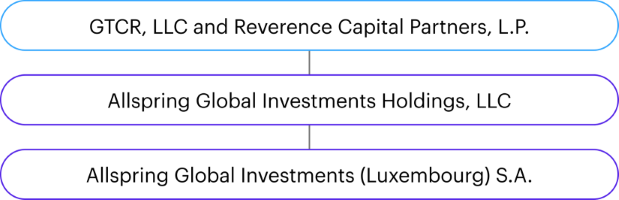
Sovereign ESGiQ is developed and maintained internally by Allspring Global Investments.
Set out below is a chart illustrating the primary ownership structure of Allspring Global Investments (Luxembourg) S.A.:
Fees and business model
Sovereign ESGiQ ratings are produced internally by Allspring and are not sold or licensed to clients or third parties. No separate fees are charged for Sovereign ESGiQ ratings.
Conflicts of interest
Sovereign ESGiQ is developed within Allspring’s investment organization. Potential conflicts of interest are managed and mitigated, where possible, through governance, oversight, and control frameworks applicable to Allspring’s research and investment activities.
Important Information
Allspring Global InvestmentsTM (Allspring) is the trade name for the asset management firms of Allspring Global Investments Holdings, LLC, a holding company indirectly owned by certain private funds of GTCR LLC and Reverence Capital Partners, L.P. These firms include but are not limited to Allspring Global Investments Luxembourg, S.A.; Allspring Funds Management, LLC; Allspring Global Investments, LLC; Allspring Global Investments (UK) Ltd.; Allspring Global Investments (Singapore) Pte. Ltd.; Allspring Global Investments (Hong Kong) Ltd.; and Allspring Global Investments (Japan) Ltd.
Unless otherwise stated, Allspring is the source of all data (which is current or as of the date stated). Content is provided for informational purposes only. Views, opinions, assumptions, or estimates are not necessarily those of Allspring or their affiliates and there is no representation regarding their adequacy, accuracy, or completeness. They should not be relied upon and may be subject to change without notice. Any benchmark referenced is for comparison purposes only, unless specified.