
Pre-COP31 Investor Outlook: Key Themes for Antalya 2026
The 31st United Nations Conference of the Parties (COP31) could reshape market signals across electrification, infrastructure, and climate finance. Read about the implementation tests and capital market themes we think investors should monitor.

11/4/2026
5 min read
Topic
Sustainable Investing
Key takeaways
- The success of COP31 may depend on turning climate targets into funded policies, infrastructure programs, and investable project pipelines.
- Increasing electrification to 35% of global energy demand by 2035 would raise demand for grids, storage, cooling, resilient generation, and industrial power infrastructure.
- Credit and equity investors should assess opportunities based on project bankability, transition funding, cash flow resilience, policy exposure, execution risk, and more.
Shifting from ambition to practical outcomes
COP31 will be a credibility test for climate policy and a practical test for capital markets. After years of rising ambition and uneven delivery, stakeholders should judge this year’s summit by one standard: whether governments can translate targets into investable policy, financed infrastructure, and measurable resilience. The president of this year’s conference in Antalya, Turkey, has positioned COP31 around implementation, with priorities spanning across electrification, waste reduction, climate resilient buildings, green industrialization, general climate awareness, and climate implementation bridge.1 The opportunity is meaningful, but so is the execution risk: Without stronger policy design, procurement, financing tools, and grid investment, Antalya risks producing another set of targets without the mechanisms needed to shift real-world capital allocation.
What has changed since Belém?
Belém was marketed as the “implementation COP,” but its main legacy will be a set of delivery tests rather than delivery itself. COP30 produced a package of important announcements, most notably shifting the language of climate diplomacy from ambition to implementation.2
One year on, the record is mixed. Adaptation has gained the clearest momentum through stronger indicators and a clearer signal that resilience finance must scale, but the pledge to at least triple adaptation finance by 20353 remains weakly specified. The target date is distant, the baseline is contested, and there is no automatic route from pledge to grant flows, project preparation, or lower-cost capital. The broader climate-finance agenda faces the same problem, as discussed below. Beyond finance, progress on the proposed fossil fuel and deforestation road maps is even less certain. Both sit outside the formal negotiated text and depend on coalition-building rather than enforceable consensus.
What we’re watching for from COP31
1. Can COP31 turn priorities into investable pathways?
The first test for COP31 is whether its Action Agenda4 can evolve into a credible implementation pathway—one that links priority sectors to national policy frameworks, financing structures, and project pipelines. Antalya is expected to seek commitments to raise electricity's share of final energy demand to 35% by 2035,5 lower the increase in waste, improve building energy efficiency, increase circular material use,6 expand climate-resilient agriculture and education, and strengthen the Climate Implementation Bridge to link nationally determined contributions with investable projects.7 These are important areas for discussion, but they are not yet delivery mechanisms. The key question for markets is whether COP31 can link these priorities to policies, procurements, revenue models, and financing tools capable of translating ambition into capital allocation.
Figure 1 illustrates the challenge clearly. Achieving a 35% electrification share would require global electricity demand to grow by around 4.3% annually over the next decade, compared with 2.9% over the previous 10 years. That gap represents the investment opportunity. It implies a larger and faster buildout of grids, substations, transmission and distribution networks, energy storage, system flexibility, cooling infrastructure, industrial electrification, and resilient power generation assets (i.e., solar, wind, combined cycle gas turbine, nuclear, and more).
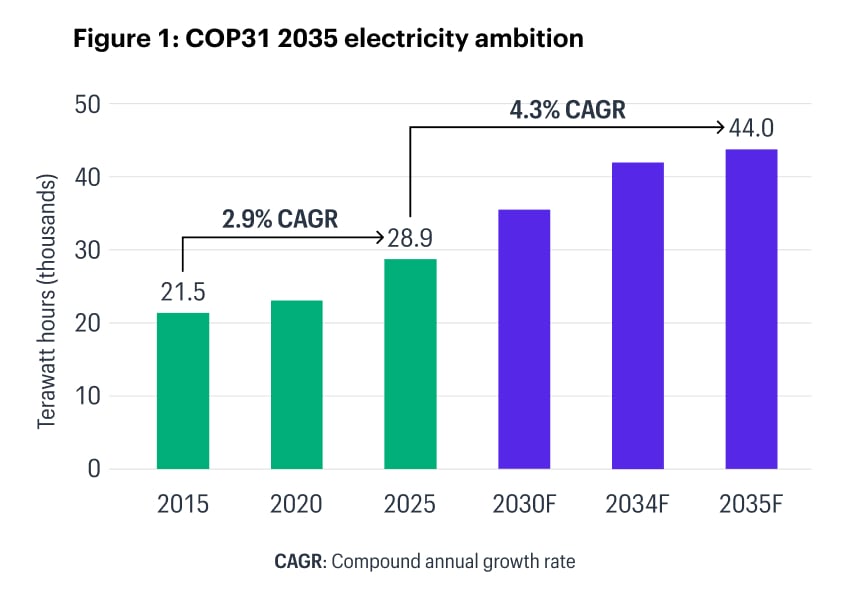
Sources: Allspring and International Energy Agency, as of Sep-26
2. Will net-zero delivery be financeable despite 1.5 degrees Celsius overshoot and climate volatility?
A core COP31 discussion point should be whether countries can keep net-zero implementation financeable in a world where 1.5 C is increasingly likely to be exceeded, at least temporarily. The UN Environment Programme’s (UNEP’s) latest emissions-gap assessment points to current policies leaving the world on a roughly 2.8 C trajectory this century, with full implementation of current nationally determined contributions implying around 2.3–2.5 C.8 It also warns that exceeding 1.5 C is very likely within the next decade9 unless emissions cuts accelerate sharply. That makes COP31 less about whether Paris remains symbolically alive and more about what governments do next: strengthen 2035 nationally determined contributions, close the implementation gap, finance emerging markets and developing economies (EMDE) mitigation, and/or scale adaptation fast enough to reduce economic damage.
A strong 2026–27 El Niño would make that debate more urgent by increasing the risk of crop losses, hydropower volatility, heat-related grid stress, flooding, logistics disruption, and insurance repricing. This is highly relevant for markets as climate shocks could lift food and energy inflation, increase disaster spending, or delay monetary easing. In turn, this could make it harder for governments to sustain transition subsidies, grid capital expenditures (capex), and EMDE climate finance commitments. COP31’s resilience agenda will matter if it links net-zero delivery with funded investment in grids, water systems, cooling, resilient cities, food security, early-warning infrastructure, and risk-transfer mechanisms.
3. Will climate finance delivery and EMDE bankability prevail?
Climate finance should be viewed as COP31’s bankability test rather than a headline funding pledge. The Baku-to-Belém Roadmap’s ambition to scale climate finance for developing countries to at least $1.3 trillion annually by 203510 becomes relevant for markets only if Antalya advances the tools that make EMDE projects financeable. This includes first-loss capital, political-risk insurance, foreign exchange and liquidity backstops, local-currency lending depth, guarantee capacity of multilateral development banks, faster project preparation, and clearer revenue frameworks. The investment signal is whether COP31 can reduce the practical barriers between national climate plans and projects that private capital can underwrite.
Why should investors care?
COP31 can influence some of the core inputs behind equity and credit valuation: revenue visibility, capex requirements, refinancing risk, cost of capital, policy risk, and long-term asset quality. A summit cannot reprice markets on its own, but stronger implementation signals could sharpen the distinction between issuers with credible transition plans and those exposed to regulatory, stranded-asset, or physical climate risks. The more immediate investor question is what could change after the meeting: new public and private procurements, revised implementation plans of nationally determined contributions, adaptation finance mechanisms, grid and electrification incentives, or clearer resilience requirements that affect spending and issuer fundamentals.
For equities, we believe the focus should be on earnings durability and valuation dispersion. Companies tied to grids, electrification, resilient infrastructure, water, cooling, and transition-enabling technologies may benefit if COP31 turns policy ambition into procurement, incentives, or regulated investment. For credit, we see downside protection as the key issue: Issuers with funded transition capex, stable contracted cash flows, and access to green or transition finance should be better positioned than those facing uncertain capex, weak governance, or higher refinancing premia.
Investors should monitor whether COP31 lowers the financing barriers for climate projects, strengthens adaptation as a revenue theme, and provides greater clarity on which technologies, business models, and sectors are best positioned to benefit from the next phase of the transition. In credit, selection should favor issuers with transition capex that’s credible and cash flow resilience that’s visible. In equities, the opportunity is to identify companies whose earnings outlook and competitive positioning improve as policy, technology, and capital investment accelerate the transition.
Common questions about sustainability and COP31
- Why does COP31 matter to investors?
COP31 may provide clearer signals about climate policy implementation, infrastructure spending, financing mechanisms, and resilience requirements. These developments could influence revenue visibility, capex, refinancing conditions, policy risk, and long-term asset quality.
- What is the COP31 electrification ambition?
The proposed ambition is to increase electricity’s share of final energy demand to 35% by 2035. Reaching that level could require expanded investment in grids, storage, transmission, distribution, cooling, industrial electrification, and resilient generation.
- How could COP31 affect climate finance for emerging markets and developing economies?
Progress could depend on mechanisms that improve project bankability, including guarantees, political risk insurance, first-loss capital, local-currency lending, foreign exchange support, and faster project preparation. These tools may help connect national climate plans with projects that private investors can evaluate and finance.
- Which sustainable investing themes could gain attention?
Themes to monitor include electricity grids, energy storage, resilient infrastructure, water systems, cooling, industrial electrification, climate-resilient agriculture, and transition-enabling technologies. Outcomes will depend on whether policy ambition leads to funded programs, incentives, contracts, and investable project pipelines.
- What should credit and equity investors monitor for sustainability?
We think credit investors should focus on funded transition spending, contractual cash flows, governance, refinancing exposure, and access to transition finance. Equity investors should assess earnings durability, valuation dispersion, competitive positioning, and exposure to accelerating infrastructure investment.
1. Source: COP31 Türkiye Antalya 2026 UN Climate Change Conference
2. Source: COP30 Announcement Tracker: Key Announcements from the 2025 UN Climate Summit | Article | EESI
3. Source: Belém COP30 delivers climate finance boost and a pledge to plan fossil fuel transition | UN News
4. Source: COP31 Türkiye Antalya 2026 UN Climate Change Conference
5. Source: COP31 Announces “35% by 2035” Electrification Target | COP31
6. Source: COP31 targets increasing global circular material use to 15% as part of green industrialization
7. Source: Climate Implementation Bridge (CIB) | COP31 Türkiye
8. Source: Emissions Gap Report 2025 | UNEP - UN Environment Programme
9. Source: Limiting Overshoot - Navigating exceedance of 1.5°C and pathways towards return | UNEP - UN Environment Programme
10. Source: Baku to Belém Roadmap to 1.3T | UNFCCC
All investing involves risks, including the possible loss of principal. There can be no assurance that any investment strategy will be successful. Investments fluctuate with changes in market and economic conditions and in different environments due to
numerous factors, some of which may be unpredictable. Each asset class has its own risk and return characteristics.
This material is provided for informational purposes only and is intended for retail public distribution in the United States. Use outside the United States is for professional/qualified investors only.
CFA® and Chartered Financial Analyst® are trademarks owned by CFA Institute.
ALL-10162026-bpoeyq1j