Seeks total return, maximising investment income whilst preserving capital, by investing at least two-thirds of its assets in investment-grade US$-denominated credit debt securities
Key differentiators
- Focuses on bottom-up credit research and security selection as the primary source of alpha
- Balances competitive income and a sell discipline driven by valuation and fundamental factors
- Fully integrated team focused on income and less efficient market sectors
Performance
Past performance is not indicative of future results.
Composition
Portfolio statistics
(as of 11/30/2025)| Fund | Benchmark | |
|---|---|---|
| Number of Holdings | 201 | 9467 |
| Number of Issuers | 127.00 | 1,205.00 |
| Effective Duration | 6.67 | 6.75 |
| Weighted Average Effective Maturity | 9.95 Years | 10.14 Years |
| Average Credit Rating | A- | A- |
| Credit Spread Duration | 6.57 | 6.63 |
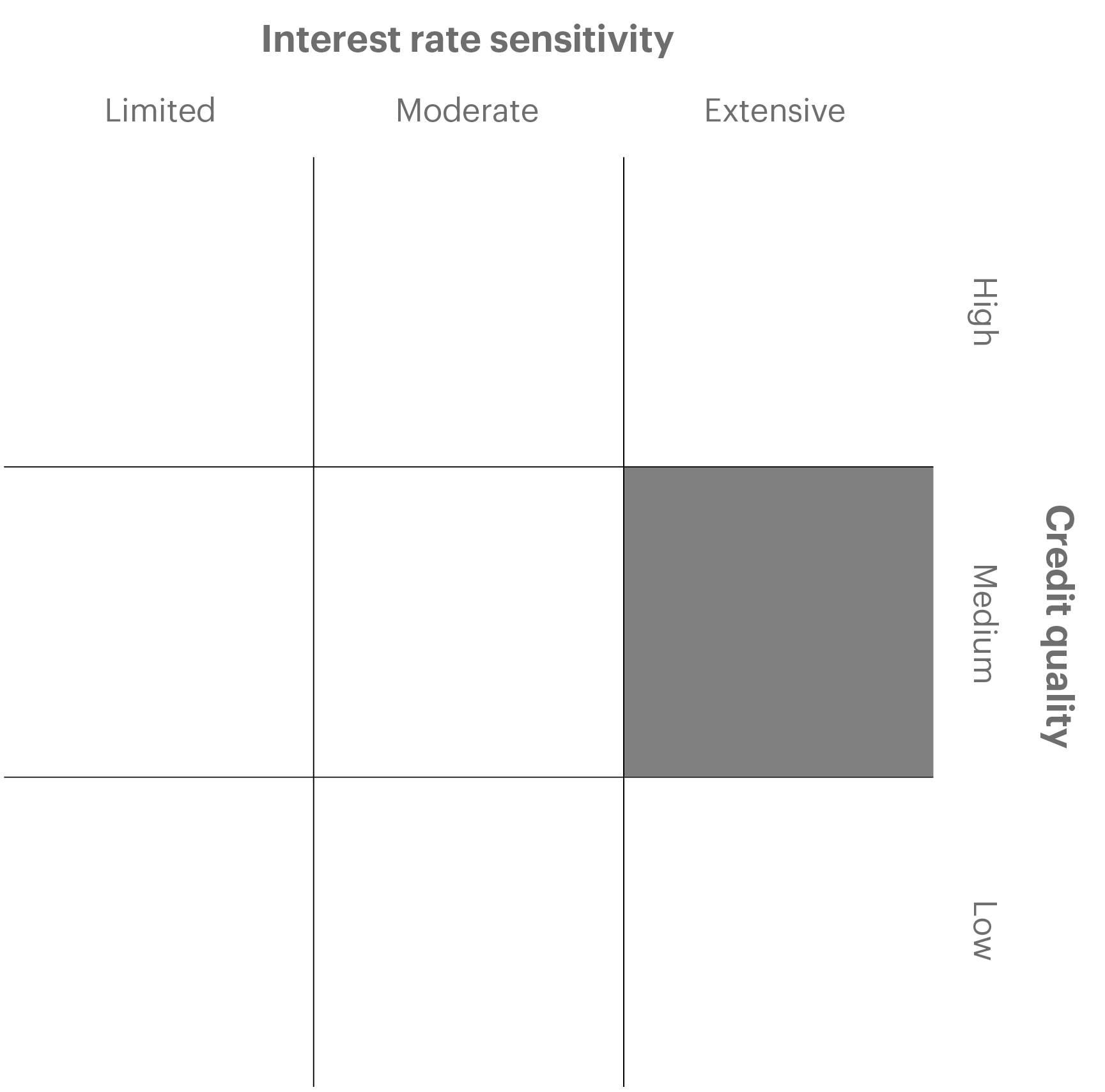
Placement within the Morningstar Fixed-Income Style Box™ is based on two variables: the vertical axis shows the credit quality of the long bonds owned and the horizontal axis shows interest rate sensitivity as measured by a bond's effective duration. For credit quality, Morningstar combines the credit rating information provided by the fund companies with an average default rate calculation to come up with a weighted average credit quality. The weighted average credit quality is currently a letter that roughly corresponds to the scale used by a leading NRSRO. Bond funds are assigned a style box placement of low, medium, or high based on their average credit quality. Funds with a low credit quality are those whose weighted average credit quality is determined to be less than BBB-, medium are those less than AA- but greater or equal to BBB-, and high are those with a weighted average credit quality of AA- or higher. When classifying a bond portfolio, Morningstar first maps the NRSRO credit ratings of the underlying holdings to their respective default rates (as determined by Morningstar’s analysis of actual historical default rates). Morningstar then averages these default rates to determine the average default rate for the entire bond fund. Finally, Morningstar maps this average default rate to its corresponding credit rating along a convex curve. For municipal bond funds, Morningstar also obtains from fund companies the average effective duration. In these cases static breakpoints are used. These breakpoints are as follows: (i) Limited: 4.5 years or less; (ii) Moderate: more than 4.5 years but less than 7 years; and (iii) Extensive: more than 7 years. In addition, for non-U.S. taxable and non-U.S. domiciled fixed-income funds, static duration breakpoints are used: (i) Limited: less than or equal to 3.5 years; (ii) Moderate: greater than 3.5 years and less than or equal to 6 years; and (iii) Extensive: greater than 6 years.
Credit quality
Credit quality
(as of 11/30/2025)|
Type
|
Fund
|
Benchmark
|
|---|---|---|
|
AAA/Aaa
|
0.97% | 6.77% |
|
AA/Aa
|
10.46% | 9.73% |
|
A/A
|
42.38% | 41.21% |
|
BBB/Baa
|
44.53% | 42.30% |
|
BB/Ba
|
0.69% | - |
|
Cash & equivalents
|
0.96% | - |
The ratings indicated are from Standard & Poor's, Fitch Ratings Ltd., and/or Moody's Investors Service. The percentages of the fund's portfolio with the ratings depicted in the chart are calculated based on total investments of the fund. If a security was rated by all three rating agencies, the middle rating was used. If rated by two of three rating agencies, the lower rating was used, and if rated by one of the agencies, that rating was used. Credit quality is subject to change and may have changed since the date specified. Percent total may not add to 100% due to rounding.
Maturity
Maturity
(as of 11/30/2025)|
Maturity Range
|
Fund
|
|---|---|
|
0 - 3 years
|
17.36%
|
|
3 - 5 years
|
21.51%
|
|
5 - 10 years
|
38.20%
|
|
10+ years
|
21.96%
|
Based on ending weights as of month-end. Percent total may not add to 100% due to rounding.
Holdings
Top 10 holdings
(as of 11/30/2025)|
Security
|
Fund
|
|---|---|
|
US Treasuries
|
2.41%
|
|
US Treasuries
|
1.39%
|
|
US Treasuries
|
1.38%
|
|
Citigroup Inc.
|
1.26%
|
|
JPMorgan Chase & Co.
|
1.26%
|
|
Manufacturers and Traders Trust Company
|
1.25%
|
|
Morgan Stanley
|
1.21%
|
|
Wells Fargo & Company
|
1.19%
|
|
Lloyds Banking Group plc
|
1.11%
|
|
Lloyds Banking Group plc
|
1.10%
|
Portfolio Composition
Portfolio composition
(as of 11/30/2025)|
Credit Assets
|
Allocation
|
Benchmark
|
|---|---|---|
|
Communications
|
12.52% | 6.66% |
|
Consumer cyclical
|
3.49% | 6.21% |
|
Consumer non-cyclical
|
8.28% | 13.02% |
|
Energy
|
2.27% | 6.35% |
|
Financial institutions
|
45.28% | 28.40% |
|
Other (government-related, securitized, etc.)
|
9.36% | 13.29% |
|
Other corporates
|
3.37% | 9.13% |
|
Technology
|
14.96% | 8.42% |
|
Utilities
|
0.48% | 8.51% |
Portfolio composition is subject to change and may have changed since the date specified. Percent total may not add to 100% due to rounding.
ESG data summary
Product involvement 3
| Portfolio | Benchmark | |
|---|---|---|
| Controversial Weapons exposure | 0.00% | 1.79% |
| Oil Sands exposure | 0.00% | 0.18% |
| Small Arms exposure | 0.00% | 0.00% |
| Thermal Coal exposure | 0.00% | 0.24% |
| Tobacco exposure | 0.00% | 1.02% |
| UN Global Compact non-compliant exposure | 0.00% | 1.51% |
¹ Data is sourced from MSCI ESG Research where companies are rated on a scale of 0 – 10 (0 - worst, 10 - best). Weighted average scores exclude effects of unrated securities.
² ESG Risk Ratings measure exposure to and management of ESG risks. Lower risk scores reflect less ESG risk. Sustainalytics ESG Risk Scores measure ESG risks on a scale of 0 – 100 (0 - no ESG Risk, >40 - Severe ESG Risk).
3 Source: Allspring Global Investments. This report contains information developed by Sustainalytics. Such information and data are proprietary of Sustainalytics and/or its third-party suppliers (Third Party Data) and are provided for informational purposes only. They do not constitute an endorsement of any product or project, nor an investment advice and are not warranted to be complete, timely, accurate or suitable for a particular purpose. Their use is subject to conditions available at https://www.sustainalytics.com/legal-disclaimers. Copyright © 2023 Sustainalytics. All rights reserved.
Controversial weapons: evidence of direct involvement in production, distribution or related services for cluster munitions, anti-personnel mines, chemical, biological, and nuclear weapons that are tailor-made and essential to the functioning of the weapons.
Oil Sands: >=5% of revenues from extraction.
Small Arms: any revenue from production or >=5% of revenue from sales or distribution of weapons to civilian customers.
Thermal Coal: >1% of revenue from extraction or >=50% revenue from power generation.
Tobacco: any revenue from production, >=5% of revenue in tobacco sales, or >=25% of revenue from related products and services.
UN Global Compact non-compliant: companies assessed to be in breach of one or more of the United Nations Global Compact principles on human rights, labour, environment, and anti-corruption.
4Carbon data includes Scope 1 and Scope 2 GHG emissions. Data sourced from MSCI ESG Research.
This report contains certain information (the “Information”) sourced from MSCI ESG Research LLC, or its affiliates or information providers (the “ESG Parties”). The Information may only be used for your internal use, may not be reproduced or redisseminated in any form and may not be used as a basis for or a component of any financial instruments or products or indices. Although they obtain information from sources they consider reliable, none of the ESG Parties warrants or guarantees the originality, accuracy and/or completeness, of any data herein and expressly disclaim all express or implied warranties, including those of merchantability and fitness for a particular purpose. None of the MSCI information is intended to constitute investment advice or a recommendation to make (or refrain from making) any kind of investment decision and may not be relied on as such, nor should it be taken as an indication or guarantee of any future performance, analysis, forecast or prediction. None of the ESG Parties shall have any liability for any errors or omissions in connection with any data herein, or any liability for any direct, indirect, special, punitive, consequential or any other damages (including lost profits) even if notified of the possibility of such damages. Certain information ©2025 MSCI ESG Research LLC. Reproduced by permission; no further distribution.
To deliver strong performance for clients, the team maintains an intense focus on finding high-quality, well-underwritten bonds with a competitive income advantage.
Key risks
Debt securities risk: Debt securities are subject to credit risk and interest rate risk and are affected by an issuer’s ability to make interest payments or repay principal when due.
Asset-backed securities risk: Asset-backed securities may be more sensitive to changes in interest rates and may exhibit added volatility, known as extension risk, and are subject to prepayment risk.
High yield securities risk: High yield securities are rated below investment grade, are predominantly speculative, have a much greater risk of default and may be more volatile than higher-rated securities of similar maturity.
ESG risk: Applying an ESG screen for security selection may result in lost opportunity in a security or industry resulting in possible underperformance relative to peers. ESG screens are dependent on third-party data and errors in the data may result in the incorrect inclusion or exclusion of a security.
Contingent convertible bonds risk: These instruments can be converted from debt into equity because of the occurrence of certain predetermined trigger events including when the issuer is in crisis resulting in possible price fluctuations and potential liquidity concerns.
Geographic concentration risk: Investments concentrated in specific geographic regions and markets may be subject to greater volatility due to economic downturns and other factors affecting the specific geographic regions.
Global investment risk: Securities of certain jurisdictions may experience more rapid and extreme changes in value and may be affected by uncertainties such as international political developments, currency fluctuations and other developments in the laws and regulations of countries in which an investment may be made.
Leverage risk: The use of certain types of financial derivative instruments may create leverage which may increase share price volatility.

Investors should note that, relative to the expectations of the Autorité des Marchés Financiers, this fund presents disproportionate communication on the consideration of non-financial criteria in its investment policy.
The ongoing charges/total expense ratio (TER) reflects annual total operating expenses for the class, excludes transaction costs and is expressed as a percentage of net asset value. The figure shown is from current KID. The investment manager has committed to reimburse the Sub-Fund when the ongoing charges exceed the agreed upon TER. Ongoing charges may vary over time.
Any benchmark referenced is for comparative purposes only, unless specifically referenced otherwise in this material and/or in the prospectus, under the Sub-Funds’ Investment Objective and Policy.
†Promotes environmental and social characteristics but does not have a sustainable investment objective
†While the Sub-Funds listed above have access to both internal and external ESG research and integrate financially material sustainability risks into their investment decision-making processes, ESG-related factors are considered but not determinative, permitting the relevant Sub-Investment Managers to invest in issuers that do not embrace ESG; as such, sustainability risks may have a more material impact on the value of the Sub-Fund’s investments in the medium to long term. The investments underlying these Sub-Funds do not take into account the EU criteria for environmentally sustainable economic activities.
The Morningstar Rating™ for funds, or star rating, is calculated for managed products (including mutual funds, variable annuity and variable life subaccounts, exchange-traded funds, closed-end funds, and separate accounts) with at least a three-year history. Exchange-traded funds and open-ended mutual funds are considered a single population for comparative purposes. It is calculated based on a Morningstar risk-adjusted return measure that accounts for variation in a managed product's monthly excess performance, placing more emphasis on downward variations and rewarding consistent performance. The Morningstar Rating does not include any adjustment for sales loads. The top 10% of products in each product category receive 5 stars, the next 22.5% receive 4 stars, the next 35% receive 3 stars, the next 22.5% receive 2 stars, and the bottom 10% receive 1 star. The Overall Morningstar Rating for a managed product is derived from a weighted average of the performance figures associated with its 3-, 5-, and 10-year (if applicable) Morningstar Rating metrics. The weights are: 100% 3-year rating for 36–59 months of total returns, 60% 5-year rating/40% 3-year rating for 60–119 months of total returns, and 50% 10-year rating/30% 5-year rating/20% 3-year rating for 120 or more months of total returns. While the 10-year overall star rating formula seems to give the most weight to the 10-year period, the most recent 3-year period actually has the greatest impact because it is included in all three rating periods. Past performance is no guarantee of future results.
© 2024 Morningstar. All rights reserved. The information contained herein is proprietary to Morningstar and/or its content providers; may not be copied or distributed; and is not warranted to be accurate, complete, or timely. Neither Morningstar nor its content providers are responsible for any damages or losses arising from any use of this information. Past performance is no guarantee of future results.