
Allview: Market Risk Monitor
Each month, Allspring’s Investment Analytics team assembles a top 10 list of market risks that it believes could potentially influence investment portfolios. The October edition also features a special report on the U.S. midterm elections.
Explore Full PDF
Authors
-
Investment Analytics Team
10/5/2026
6 min read
Topic
Risk Management
Key takeaways
- The four biggest themes from our list continue to include: fears of higher interest rates, two wars that are influencing energy prices, pockets of potential fixed income defaults, and a constant debate around whether artificial intelligence stocks have entered bubble territory.
- Bond vigilantes (our new #1 risk) have returned to fixed income markets—a trend that could persist for the foreseeable future.
- U.S. markets will likely turn their attention to the November midterm elections. While we’ve moved the risk of a “blue wave” up our list this month, the results are more likely to affect select industries rather than the entire market as a whole.
U.S. midterm elections special report
The pattern for markets after the U.S. midterm elections has been powerful
Since 1950, the S&P 500 has delivered positive 12-month total returns after every midterm election shown. The average gain was 18.8%, with outcomes spanning multiple administrations and both political parties.
S&P 500 index total return (%) in the 12 months following midterm elections
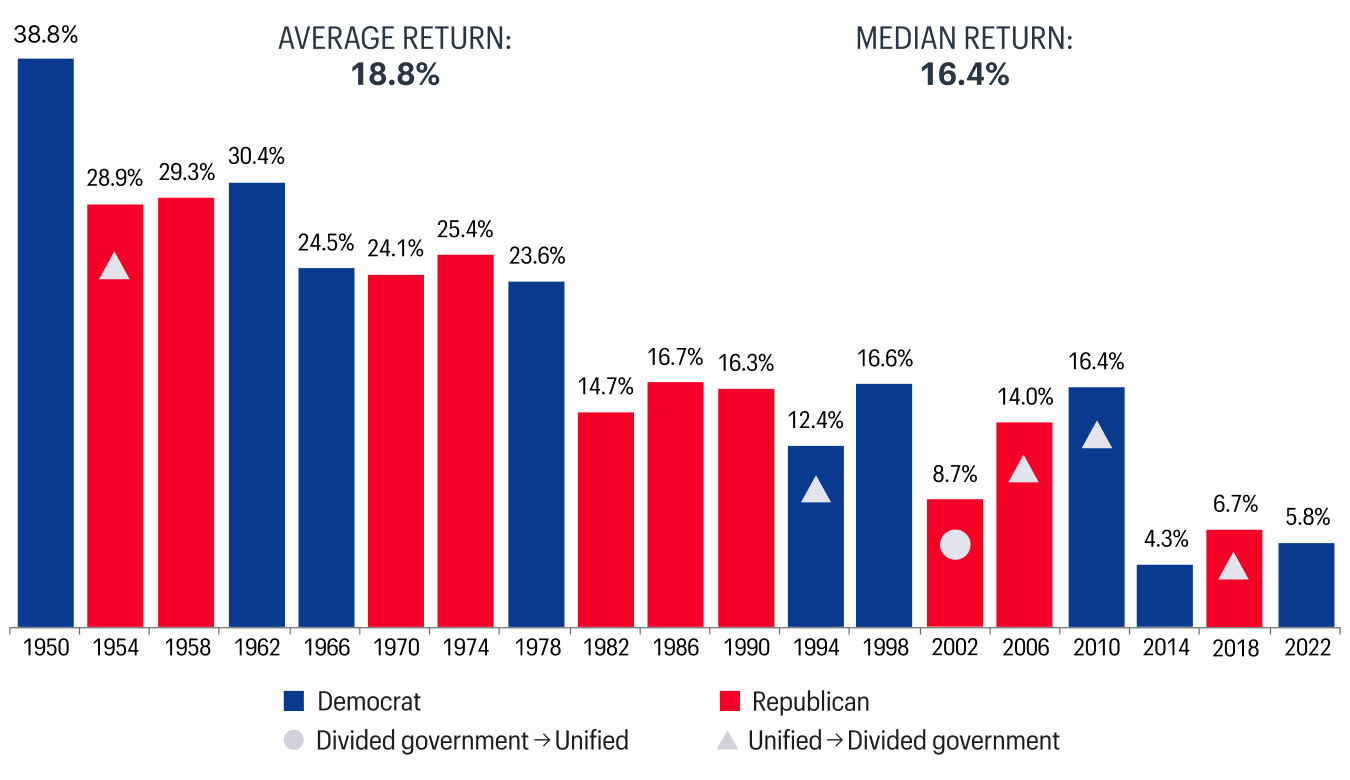
Sources: Allspring and Bloomberg Finance L.P. Data from 1950–2024. The chart shows S&P 500 total returns from each midterm election date through one year later. Party reflects the incumbent president. Past performance does not guarantee future results.
Looking back at historical midterm elections, all 19 periods shown were positive. Divided/unified government transitions did not demonstrate large effect.
Common questions about market risks and Allspring’s investment risk management
- What are the top market risks investors should monitor today?
Investors should currently be monitoring interest rate changes, inflation trends, economic slowdowns, geopolitical tensions, and market volatility. Additional risks may include currency fluctuations, policy changes by central banks, and unexpected global events. For a concise summary and checklist, download Allspring’s latest top 10 market risks in the Market Risk Monitor monthly publication.
- How can investors protect their portfolios from market volatility?
Investors can potentially manage market volatility by diversifying across asset classes, sticking to a long-term investment strategy, or using a variety of portfolio risk management techniques. Holding a mix of stocks, bonds, and alternative investments can reduce portfolio sensitivity to sudden market swings while helping preserve capital during downturns. Explore Allspring’s range of investment strategies to see how we can help solve for your allocation needs.
- Why is investment risk management important?
Portfolios are exposed to a range of risks that can affect performance, such as market volatility, credit events, liquidity constraints, and concentration risk. A consistent risk framework promotes discipline, transparency, and resilience, particularly during periods of market uncertainty.
- What types of risks are commonly monitored by asset managers?
Asset managers commonly monitor market, credit, liquidity, and concentration risks to understand how economic and security-specific events may affect portfolio performance. Many also assess factor and correlation risk to evaluate how positions may behave together under different conditions. Scenario analysis and stress testing are also often used to examine potential impacts from adverse or unexpected market events, supporting stronger portfolio risk oversight.
- What role does Allspring’s Investment Analytics team play in risk management?
Our risk management capabilities are supported by the Investment Analytics team, which consists of over 35 professionals dedicated to portfolio analytics and oversight. The team leverages a highly automated platform that combines proprietary tools with external risk models, drawing on capabilities across equity, fixed income, multi-asset, portfolio analytics, and quantitative insights. This integrated approach enhances transparency and helps deliver consistent, data-driven risk insights.
- How often does Allspring provide investment risk management reporting?
Our customized analytics include daily risk and performance reporting, delivering consistent insights into portfolio exposures and dynamics. This reporting supports informed portfolio oversight as market conditions and portfolio characteristics evolve. Additionally, the Allspring Investment Analytics team assembles a list of market risks that it believes could influence investment portfolio decisions and releases findings via the Allview Market Risk Monitor.
- How does Allspring’s investment risk management potentially benefit clients?
Our risk management process aims to provide clients with greater transparency and clarity around portfolio risks. Through disciplined portfolio risk oversight and consistent analysis, our goal is to support more predictable outcomes and effective communication, even during periods of heightened market volatility.
This material is provided for informational purposes only and is intended for retail public distribution in the United States. Use outside the United States is for professional/qualified investors only.
The S&P 500 Index consists of 500 stocks chosen for market size, liquidity, and industry group representation. It is a market-value-weighted index with each stock’s weight in the index proportionate to its market value. You cannot invest directly in an index. This material is provided for informational purposes only and is intended for retail public distribution in the United States. Use outside the United States is for professional/qualified investors only.
Diversification does not ensure or guarantee better performance and cannot eliminate the risk of investment losses.
ALL-09242026-il0v353x