
An Investor’s Guide to the AI Infrastructure Stack
The artificial intelligence (AI) boom is supported by a vast infrastructure stack. Understanding the role of key players such as hyperscalers, semiconductors, and data centers is crucial for identifying investment opportunities beyond the headlines.
Key takeaways
- AI investing extends far beyond popular AI labs and their popular applications such as ChatGPT or Claude. Behind every AI model sits a massive infrastructure stack that enables the industry to operate at scale.
- While hyperscalers dominate the headlines, companies in the power, cooling, and physical infrastructure space are increasingly in focus as AI bottlenecks emerge.
- Today, attractive investment opportunities in AI may be in small and medium-sized firms that can efficiently and quickly solve growing infrastructure concerns.
Inside the AI ecosystem
Few innovations have evolved as quickly as AI, and the language surrounding its ecosystem has expanded just as fast. To help demystify the AI value chain, Allspring Global Investments has built a useful framework for identifying where investment dollars are being spent and where attractive growth opportunities are emerging.
Most people interact with AI through end-user applications like ChatGPT, Claude, Gemini, or Copilot. These apps are developed by AI model providers, sometimes referred to as “AI labs,” that, despite their novelty, generate revenue much like a cellular provider. Some users pay a monthly subscription while others are billed based on users’ token consumption, which represents the compute power required to perform a task. Yet, every AI interaction, no matter how complex or simple, depends on a scaffolding of infrastructure, with different participants capturing economic value at each step.
Who supplies the technology that enables the AI models? The key layers of the value chain, or infrastructure “stack,” are below:
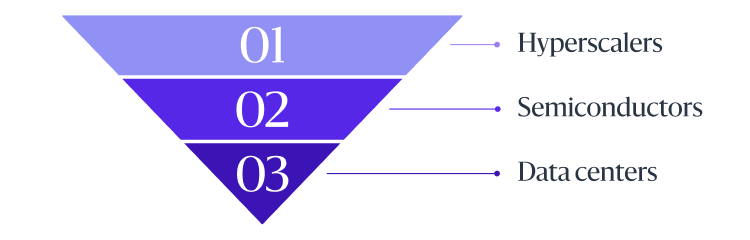
Hyperscalers: Supplying cloud capacity
Cloud-computing services are the first ingredient required for training and deploying AI models. As AI adoption accelerates, demand for cloud-computing increases on a massive scale.
- Hyperscalers are large tech companies supplying the compute and physical infrastructure required to deliver AI. These companies are fighting to win the largest share of cloud-computing business to become the “toll roads” for AI and they are investing heavily to do so. The largest hyperscalers are Microsoft, Amazon, Google, Meta, and Oracle.
- “Circular” relationships: Many model providers maintain strategic relationships with these hyperscalers. For example, OpenAI has ties to Microsoft Azure and Oracle, while Anthropic uses both Amazon Web Services and Google Cloud. These relationships are viewed as circular because the hyperscalers are some of the largest investors and customers of the model providers themselves. These alliances are critical to the ultimate deployment of AI applications to consumers and enterprises alike.
- Neoclouds are similar to hyperscalers in that they supply cloud-computing services but are smaller and more specialized. Neoclouds specialize in building pathways for efficient AI traffic so that models can be trained and run at scale. Leading neoclouds are currently CoreWeave, Nebius, Hut 8, and DigitalOcean, though each occupies a slightly different niche (be it model training, physical power, or deployment for enterprises) in the industry.
Semiconductors: Processing AI workloads
Semiconductors play a critical role in the AI ecosystem, and technical experts often discuss this layer in terms of “racks.” Racks are large systems packed with dozens of processing and memory chips (GPUs) and networking equipment that work together as a single processing unit to develop large-scale AI models.
This layer captures a disproportionate share of hyperscalers’ spend because it is arguably the most important in the stack. To illustrate its magnitude, a single rack costs several million dollars and data centers often house tens of thousands of racks. The rest of the AI infrastructure stack exists primarily to support and scale “compute” or processing capacity. Key components include:
- Graphics processing units (GPUs): Often called “accelerators,” GPUs are high-performance chips that power AI by accelerating massive mathematical calculations, integrating multiple processing or “logic” chips into a single unit through what’s called “advanced packaging.”
- NVIDIA captures a significant portion of the economics of this layer because its GPUs are the default for training and deploying AI models. Advanced Micro Devices also designs processing chips and is a primary competitor to NVIDIA.
- ASICs and foundries: Application-specific integrated circuits (ASICs) are specialized processing chips designed to perform specific AI tasks with greater speed and efficiency and lower power consumption than general-purpose GPUs. Similar to GPUs, most ASIC companies operate on a fabless model, meaning they design chips but rely on third-party foundries to manufacture them. Broadcom, Marvell, and Cerebras design ASICs and rely on foundries including TSMC, Samsung, and Intel for manufacturing.
- Memory and storage: Dynamic random-access memory (DRAM) and ultra-fast high-bandwidth memory (HBM) chips integrated with GPUs supply data for active processing, while NAND flash storage sits outside the GPU and holds data until needed. Leading memory providers include Micron, SK hynix, and Samsung, while leading storage providers include Sandisk, Western Digital, and Seagate.
Data centers: The physical infrastructure
Data centers house all the physical equipment required to host AI workloads. Companies supplying technologies for this foundational infrastructure layer benefit from the hyperscalers’ massive investment in increased AI capacity. Examples of such technologies include:
- Power: AI requires massive amounts of power, and by 2030, it is estimated that data centers will consume around 1,000 terawatt-hours of electricity annually—roughly the same amount as Japan’s total annual electricity consumption today1. To meet this demand, a massive investment to modernize and expand U.S. electrical infrastructure will be needed, with power companies like Quanta Services benefiting from custom services and labor. Data centers are also increasingly adopting “behind the meter” solutions or specialized generators from providers like Bloom Energy or GE Vernova to power buildings without needing to rely on the long and cumbersome process of connecting to the existing electrical grid.
- Cooling and thermal management: Data centers generate substantial amounts of heat that must be continuously managed to maintain reliable operations. Industrial-scale HVAC systems (from companies like Comfort Systems and EMCOR) help maintain optimal temperatures, while key mechanical components such as the pumps, valves, and fluid-management devices (from firms like Johnson Controls and Modine Manufacturing) are crucial for regulating temperatures inside the buildings. The actual racks themselves also have their own liquid cooling solutions, and Vertiv Holdings is one of the key suppliers in this area.
- Interconnect: This refers to the cables that transmit the power and signals that make AI possible. Cabinets and containment systems provide organized structure for efficient power delivery and airflow within dense compartments of equipment. In terms of connection materials, copper is widely used and highly effective but heat intensive. Fiber-optic connectors offer greater efficiency but require more precise manufacturing, installation, and testing. Credo, Astera Labs, and Amphenol have historically offered copper interconnect but are increasingly offering optical as well. Viavi Solutions provides the testing and measurement needed to validate high-speed optical networks at scale.
- Colocation: Real estate providers such as Equinix, Digital Realty, QTS, and CyrusOne develop and operate data center facilities. They often lease space and provide services to hyperscalers and other customers rather than owning AI equipment themselves. Within the data centers, automation technologies include the sensors and control systems that optimize power and facility operations with Schneider Electric and Siemens supplying these technologies.
Allspring Growth team perspective: Go deeper into the stack
The scale of the AI infrastructure buildout is unlike anything this country has seen in modern times, only potentially rivaled in U.S. history by the railroad boom in the 1800s. In the first stage of the AI investment cycle, hyperscalers and mega-cap tech giants such as Amazon, Microsoft, Alphabet, Micron, and NVIDIA dominated headlines and captured the lion’s share of investment returns.
But an important shift is now underway, with investors increasingly rewarding the recipients of AI capital spending rather than the spenders themselves. The focus has broadened from the companies funding the buildout to the companies enabling it, including infrastructure providers that are helping scale capacity and address key constraints in areas such as power and storage.
Next-generation data centers are measured in terms of gigawatts, or the amount of compute capacity generated by 1 billion watts of power. A single gigawatt is similar to the amount of power consumed by a metropolitan area like Indianapolis, Indiana with around 800,000 households2. For context, the amount of capital required to stand up a 1-gigawatt data center is estimated to be around $35 billion and some believe nearly 100 gigawatts in data centers will be added by the end of the decade3.
Linked to this power buildout, businesses in the industrials sector are increasingly in focus. These companies often have order backlogs extending several years into the future, helping create durable and visible earnings growth, and easing investors’ fears around speculative excess.
Furthermore, the market is broadening and beginning to reward small and medium-sized companies with innovative solutions to modern challenges. One area our research is focused on is the power and cooling of massive data centers. Temperature control can take up as much as 40% of data center energy usage overall, so there is an immense financial incentive to come up with cutting-edge solutions to become more efficient4.
Ultimately, investing in AI today involves searching for opportunity beyond the headline names. That’s why we believe investors who look deeper into the infrastructure stack may be positioned to benefit during the next stage of AI growth. Active managers can uncover compelling opportunities among the recipients of AI-related capital spending through fundamental research across industrial, power, technology, and infrastructure companies. As the AI buildout evolves, we are increasingly focused on areas where demand is outpacing available capacity. These bottlenecks often create attractive opportunities for the businesses supplying the infrastructure, equipment, and services needed to unlock additional scale.
Common questions about AI investing
- What is the AI infrastructure stack?
The AI infrastructure stack refers to the layers of technology that enable and support AI labs to function at scale. The ecosystem includes hyperscalers that provide cloud-computing services, semiconductor manufacturers that supply processing capabilities, and data center operators that provide physical infrastructure (such as the building and power) needed to run AI workloads.
- What is a hyperscaler?
Hyperscalers are large tech companies that provide cloud-computing infrastructure to the AI labs. This infrastructure is crucial for training, deploying, and running AI models and is supplied by tremendous investment from mega-cap companies such as Amazon, Microsoft, Google, Meta, and Oracle.
- What is a “neocloud” company?
Neocloud companies are specialized cloud-computing providers that focus on improving AI training and outputs for companies. Their efforts help firms more efficiently use AI computing resources or develop better results. Their specialization in this aspect of the AI value chain allows these companies to reach where hyperscalers don’t.
- Why are semiconductors crucial for AI?
Graphics processing units (GPUs) and application-specific integrated circuits (ASICs) perform the complex mathematical calculations that underpin AI model outputs. Demand for these chips has been a key feature of the first part of the AI revolution and companies producing these chips have seen soaring revenues as a result.
- Why is power increasingly seen as an AI bottleneck?
AI data centers require enormous amounts of electricity to process calculations and provide outputs for users. As AI demand increases, some estimates suggest that AI power consumption could rise to nearly 10% of the total electricity produced in 20305. With such massive power needs, companies that are in the business of transmitting and generating energy are increasingly in focus for those in the AI industry.
- What is a “token” and how do AI companies make money from it?
A token, or AI compute, is a unit of data processed by an AI model. AI labs charge customers based on the amount of tokens they consume, and this is generally done in a subscription model for individual users or a usage-based model for larger, enterprise customers.
Related insights

Rising Treasury yields were the top story for Q3, leading to volatile trading and changing leadership among investment factors. Looking ahead to Q4, John Campbell discusses his outlook and important market segments to watch to close out 2026.

As global investors look to broaden their opportunity set, emerging markets small caps may offer a differentiated path to growth, diversification, and active management alpha.

A risk-on rally fueled by AI and earnings strength set the tone, but elevated expectations and macro uncertainty may shape a more volatile path ahead. Allspring’s Head of Systematic Core Equity, John Campbell, recaps second-quarter market performance and highlights the importance of diversification and risk management.

AI investing is moving beyond the Magnificent 7. As adoption spreads, opportunities are emerging across the broader ecosystem—from infrastructure to real-world applications—making a more diversified, multi-layered approach increasingly important.
Despite heightened geopolitical volatility, emerging markets remain undervalued and under-owned, with long term structural tailwinds creating compelling opportunities for active investors.

John Campbell reviews Q1 volatility, emphasizing risk management and strategic focus amid uncertainty.

Alison Shimada highlights emerging markets' resilience, global importance, and investment opportunities amid geopolitical challenges.
As passive investing dominates market flows, John Campbell, head of Systematic Core Equity at Allspring Global Investments, examines the risks of peak passive concentration and the case for broader diversification.

Emerging markets (EM) have undergone a structural shift, with stronger external balances, rising credit quality, and broadening earnings growth reshaping their risk profile and investment appeal in 2026.

Listen to John Campbell from our Systematic Core Equity team discuss how multiple perspectives reveal the full picture of risk.

John Campbell reviews 2025's market performance, highlights elevated factor risks, and emphasizes a multidimensional approach to risk management and diversification for 2026.

Bryant VanCronkhite highlights the evolving AI landscape, a shift in small-cap market dynamics, and the potential for a massive multi-industry upgrade cycle driving economic and market growth in 2026.
Alison Shimada and Derrick Irwin discuss why now presents a pivotal time for investors looking at the asset class. Discover the shifting global dynamics and themes shaping the future of emerging markets (EMs) from two different perspectives.
1Source: International Energy Agency (IEA), Energy and AI, April 2025
2Source: Empirical Research Partners, July 2026
3Source: Jefferies, September 2025
4https://www.energy.gov/articles/doe-announces-40-million-more-efficient-cooling-data-centers
5https://energy.mit.edu/current-initiatives/data-center-power-demand/
The securities listed in this article should not be considered a recommendation to purchase or sell any particular security
This material is provided for informational purposes only and is intended for retail public distribution in the United States. Use outside the United States is for professional/qualified investors only.
CFA® and Chartered Financial Analyst® are trademarks owned by CFA Institute.
ALL-09302026-guxnsrdl