
How Direct Indexing Works: Unlock SMArt Possibilities
Explore the ins and outs of direct indexing, why it matters, and how it can be used to create personalized, tax-smart investment strategies.
Quick Guide PDF
8/25/2026
12 min read
Topic
Direct Indexing
Key takeaways
- Direct indexing allows investors access to index-based exposures while retaining direct ownership of individual securities, offering enhanced control and customization options.
- Advances in technology and cost reductions have made direct indexing more accessible, addressing growing demand for personalized investment strategies.
- Key benefits include robust tax management, tailored portfolio capabilities, full portfolio transparency, and flexible transition strategies.
Index mutual funds and exchange-traded funds (ETFs) have long been staples of index investing, but direct indexing is emerging as a compelling, more personalized option for investors to help build and manage their portfolios.
Direct indexing is hardly a novelty, but it’s mostly been reserved for select firms and high-net-worth investors historically. Thanks to advancements in trading technology and lower fees, direct indexing has become a viable and more accessible strategy for many investors.
What is direct indexing?
In its purest form, direct indexing is the process of replicating an index’s performance through owning its underlying securities individually. For example, an investor could attempt to track the S&P 500 Index by purchasing an S&P 500 direct index separately managed account (SMA). The portfolio would typically hold a representative sample of securities in the index, optimized to mimic its risk and return characteristics. The portfolio is rebalanced and reconstituted periodically in alignment with the index.
Unlike mutual funds and ETFs, because direct indexing is created through an SMA, it offers its investors direct ownership of the securities in the portfolio. This provides them with several key advantages, including greater control, flexibility, transparency, and personalization of portfolio holdings that may be customized to align with their individual goals. It also allows for enhanced, proactive, and ongoing tax management.
Wealth management is evolving
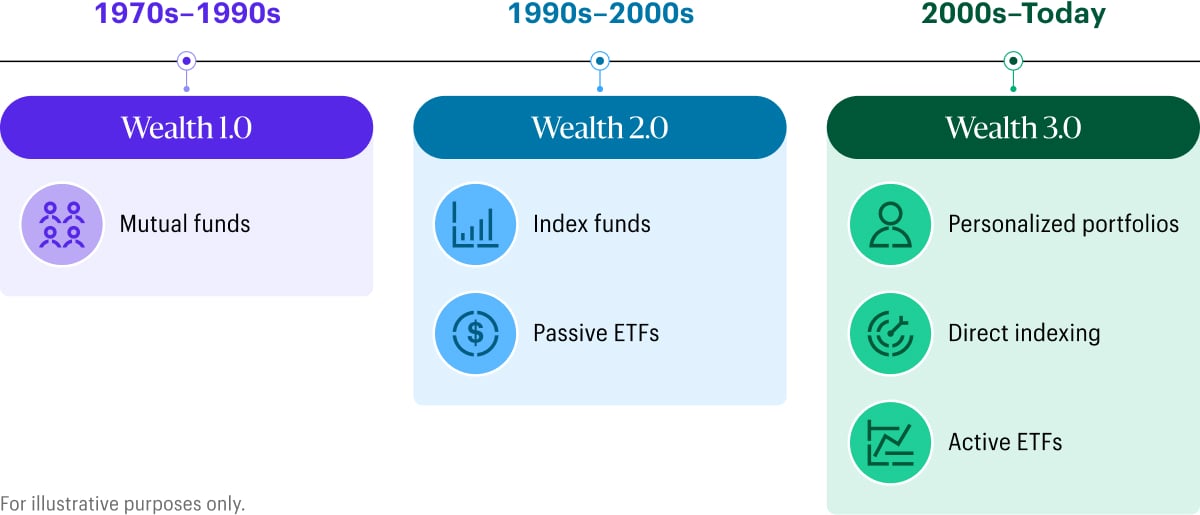
How can investors access direct indexing today?
Before the rise of online brokerage platforms, direct indexing wasn’t feasible for most investors. Manually constructing a portfolio to mirror an index of hundreds of securities used to be an expensive, time-consuming undertaking—not to mention the ongoing maintenance efforts required to rebalance and reconstitute the portfolio.
Today, direct indexing is a far more realistic strategy thanks to enhanced technology, reduced trading fees, streamlined trading platforms, and accessible products, which collectively lowered the barrier to entry. Moreover, it aligns with the budding theme of personalized financial services. Customization is among the top priorities in the portfolio construction process for advisors as more investors seek tailored portfolios and investment strategies that cater to their specific needs, goals, and values. The direct ownership of securities and transparency of the portfolio help make this possible.
Direct ownership
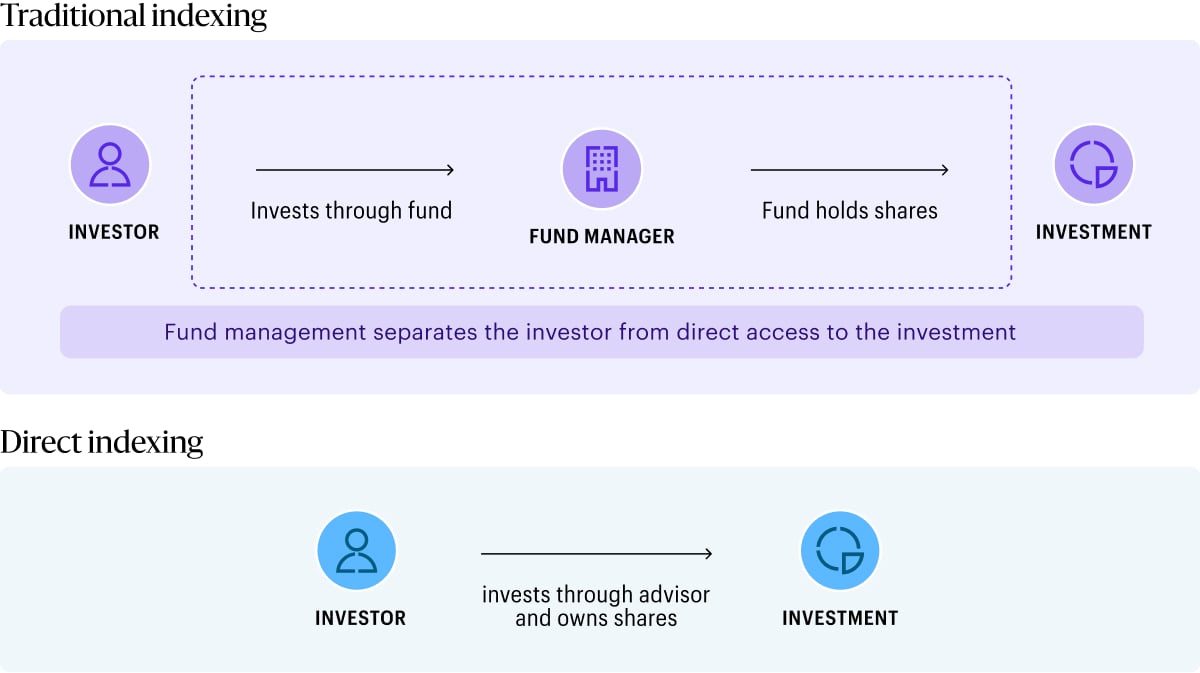
Direct indexing provides direct access to individual securities that may comprise an index. By directly owning the securities, the investor can benefit from the added flexibility that has historically been more accessible to the ultra-wealthy, institutions, and fund managers. For illustrative purposes only.
Given its investor-friendly capabilities, it’s no surprise that direct indexing has flourished—a trend that’s expected to continue in the coming years. Thanks to investor demand combined with rapid adoption by advisors and wealth managers, direct indexing has grown to over $1 trillion as of year-end 2025.1
Why use direct indexing?
Tax alpha
Because investors have direct ownership of the portfolio securities, there may be opportunities to exploit volatility and generate tax alpha throughout the life of a portfolio, especially compared with traditional funds.
Investors may do this by taking advantage of isolated stock movements within the portfolio. This is important because while a portfolio’s overall value can increase, its underlying positions may have losses that present opportunities for tax-loss harvesting. With direct indexing, investors can take advantage of tax-loss harvesting opportunities at the individual security level, even in up markets.
Up or down, taxes always matter
Investors may have opportunities to reduce their capital gains tax liability through tax-loss harvesting. We can see this historically across all types of market environments.
The chart below shows that, over the past 35 years, an average of more than 34% of S&P 500 Index constituents have ended a calendar year with negative returns. In other words, on average, more than one-third of the index has represented potential tax-loss harvesting opportunities in any given year.2
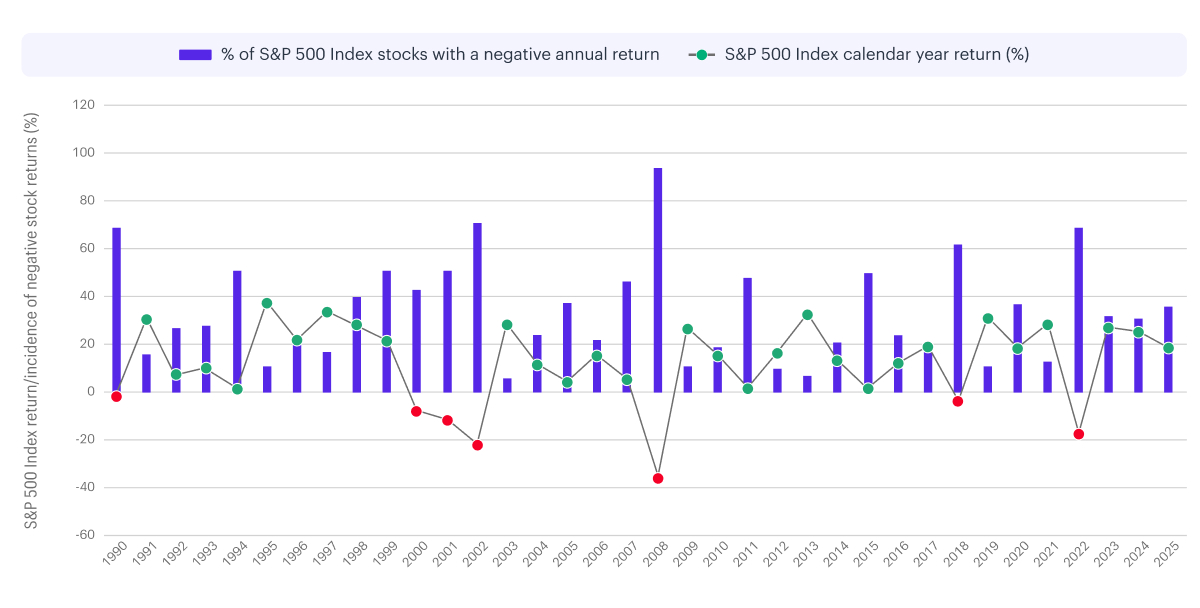
Sources: Allspring, MSCI, and Barra Portfolio Manager. As of 31-Dec-25. Past performance does not guarantee future results.
While an index may generate positive returns over a full calendar year, it’s important to remember that individual stocks within the index can experience price declines at various points throughout the year. Whether driven by an earnings miss, unfavorable headlines, changing fundamentals, broad market movements, or any number of other factors, these individual price declines can create opportunities for tax-loss harvesting. This is where a disciplined, year-round approach to tax-loss harvesting can help enhance after-tax returns. Systematic tax-loss harvesting enables investors to potentially realize losses when market downturns occur and capitalize on opportunities as markets evolve throughout the year. By contrast, investors who wait until year-end may miss opportunities to harvest losses and improve after-tax outcomes.
Can direct indexing accounts be customized?
Investors are increasingly seeking hyper-personalized financial services, and advisors are taking action. To meet this demand, many advisors are indicating that they are either using or considering using direct indexing. Since the process involves buying individual securities, portfolios can be tailored to investor preferences. For example, an investor may already hold a large portion of shares in their employer, a Fortune 500 company. By excluding these shares from their direct indexing portfolio, the client’s portfolio becomes more diversified and concentration risk is reduced.
The power of personalization
Investor scenario:
An investor holds a substantial amount of company stock. They are seeking to reduce their concentrated exposure and transition to a diversified stock portfolio, excluding the company stock as a holding.
Goals:
- Reduce single stock concentration risk
- Enhance portfolio diversification
- Increase after-tax returns
Challenges:
- Create a personalized portfolio composition to meet new goals (Example: direct indexing SMA minus company stock)
- Increase the tax efficiency of the portfolio
- Create an effective transition plan
Solutions:
- Execute an effective exit and transition plan
- Use a systematic transition process to move to a customized SMA specifically designed to meet the investor’s needs
- Fund a personalized, cost-effective, and tax-efficient direct indexing SMA
New portfolio benefits from adding direct indexing
- Reduced concentration risk
- Enhanced and ongoing tax management, creating greater tax alpha potential
- Increased portfolio flexibility, customization, and personalization
Transitioning portfolios with Allspring direct indexing and Remi
Transitioning a portfolio to a different strategy can trigger adverse tax consequences for investors, as existing positions often contain a combination of unrealized gains and losses. Unlike transitioning from a fund, direct indexing adds a layer of flexibility, as investors are not required to liquidate all holdings—allowing for more effective tax management.
A tax-aware direct indexing strategy can be employed to minimize tax liabilities during the transition, while any harvested losses could offset current or future gains. As a result, deferred unrealized gains can compound over time and potentially increase long-term wealth generation.
At Allspring, an investor can choose to minimize tracking error (more closely mirroring the index) or tax liability (prioritizing tax-loss harvesting)—or a combination of both. This allows us to cater direct indexing strategies to the priorities of the individual investor.
Emphasize tax efficiency or tracking error or balance both
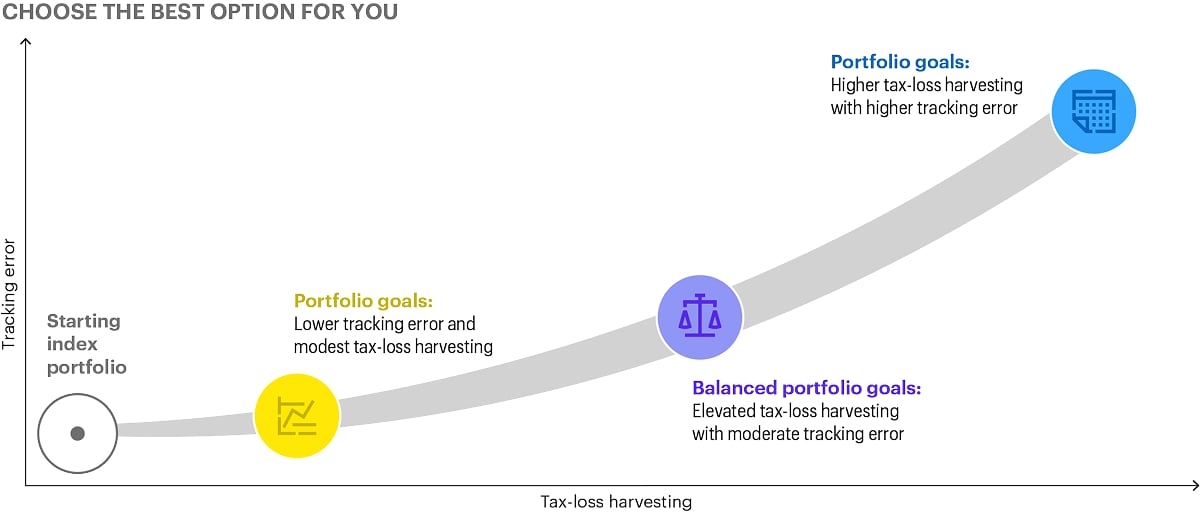
Source: Allspring. For illustrative purposes only.
To facilitate this process, Allspring provides transition analysis with a range of options that examine the tax and tracking error considerations of moving a legacy portfolio to a customized direct indexing solution in a risk-aware and tax-efficient manner.
Remi is Allspring’s technology platform founded to help advisors create value for clients with tailor-made, tax-optimized direct indexing. Remi is our intelligent SMA ecosystem that delivers customized portfolios with full-life-cycle tax management.
Common questions about Allspring's direct indexing capabilities
- What is direct indexing?
Direct indexing is an investment strategy that seeks to mimic the risk and return profile of an equity index by directly owning a representative subset of individual index securities within a separately managed account (SMA). Unlike pooled vehicles such as index mutual funds or exchange-traded funds (ETFs), direct indexing—also known as personalized or custom index investing—offers greater customization options, such as the exclusion of individual securities or industries, while also providing tax efficiency and holdings transparency. Read Allspring’s Direct Indexing FAQ.
- Who benefits from direct indexing?
Direct indexing may benefit many investors but may be of particular interest to high‑net‑worth individuals with sizable taxable portfolios—especially those in higher tax brackets, where tax‑loss harvesting can meaningfully improve after‑tax returns. It also helps investors address customization needs such as values preferences and concentrated stock positions. In addition, financial advisors and institutions may benefit by delivering more personalized, tax‑efficient solutions to their clients.
- How are direct indexing strategies implemented through separately managed accounts (SMAs)?
Direct indexing strategies are typically delivered through SMAs where investors directly own the individual securities that make up an index. The SMA structure allows portfolios to closely track a benchmark while enabling customization, tax‑loss harvesting, and risk management at the security level. Technology and portfolio manager oversight support ongoing rebalancing and tax‑aware adjustments, making SMAs an effective vehicle for implementing direct indexing at scale. Download Allspring’s direct indexing brochure.
- What is tax-loss harvesting?
Tax-loss harvesting is a tax-efficient investment strategy that involves selling securities that have declined in value and using those losses to offset capital gains and reduce tax liability. Proceeds from the sale are then reinvested in similar securities to maintain market exposure while avoiding wash-sale rules. Any losses harvested but not used in the current year can be carried forward to offset capital gains in future tax years. Direct indexing provides tax benefits by enabling security‑level tax‑loss harvesting, allowing investors to capture losses throughout the year instead of only at the fund level. Learn more about the tax benefits of direct indexing.
- How does Allspring manage tracking error?
We manage tracking error carefully, seeking to strike the right balance between capturing tax benefits and maintaining close alignment with the index. We believe this approach offers a more holistic and familiar experience for the investor. We use risk models, diversification thresholds, and substitution rules to keep exposures aligned with the target benchmark, and constraints are calibrated to balance customization with tracking control.
- How often does Allspring review direct indexing accounts?
We review accounts daily using our proprietary optimization process. Many providers only review monthly or quarterly, which can miss opportunities during market volatility. Our daily reviews allow for more opportunities to capture tax alpha while balancing savings with benchmark alignment. Download Allspring’s direct indexing brochure for more details.
- How does Allspring support advisors in implementing direct indexing for clients?
We support advisors by providing access to scalable portfolio construction, ongoing tax management, and built‑in customization capabilities. Advisors are supported with institutional‑quality execution, clear implementation frameworks, and transition plans. This approach allows advisors to deliver personalized, tax‑efficient solutions while maintaining operational efficiency and consistency. Contact the Allspring team for the best solution for your clients.
1. Source: Cerulli U.S. Managed Accounts Report 2025.
2. Sources: Allspring, MSCI and Barra Portfolio Manager. As of 31-Dec-25.
The Standard & Poor’s 500 Index (S&P 500 Index) consists of 500 stocks chosen for market size, liquidity, and industry group representation. It is a market-value-weighted index with each stock’s weight in the index proportionate to its market value. You cannot invest directly in an index.
Allspring Global Investments does not provide accounting, legal, or tax advice or investment recommendations. Any tax or legal information in this document is merely a summary of our understanding and interpretations of some of the current income tax regulations and is not exhaustive. Investors should consult their tax advisor or legal counsel for advice and information concerning their particular situation.
Source: MSCI. MSCI makes no express or implied warranties or representations and shall have no liability whatsoever with respect to any MSCI data contained herein. The MSCI data may not be further redistributed or used as a basis for other indexes or any securities or financial products. This report is not approved, reviewed, or produced by MSCI.
Diversification does not ensure or guarantee better performance and cannot eliminate the risk of investment losses.
Tracking error measures the extent to which a manager’s performance mimics that of a benchmark. The value is the standard deviation of the difference between a fund’s performance and a benchmark’s performance. Tracking error is based on historical performance and does not represent future results.
Tax alpha refers to the additional value or returns generated in an investment portfolio by incorporating strategies that minimize tax liabilities, such as tax-loss harvesting. Tax alpha is based on historical performance and does not represent future results.
Tax-loss harvesting is the selling of investments at a loss so that losses can be used to offset gains on the sale of other investments—thereby reducing capital gains tax owed. Proceeds from the sale may be used to purchase similar securities to maintain the general composition of the investment portfolio.
Systematic tax-loss harvesting aims to capture losses while maintaining a portfolio’s risk profile and relevant diversification parameters. The thresholds for and frequency of systematic tax-loss harvesting depend on market conditions and other factors.
Remi is a solution for personalizing separately managed account portfolios, powered by technology, research, and human insights. Remi’s portfolio construction engine is backed by our fundamental research team, simplified transitions, and tax management. Remi is a service of Allspring Funds Management, LLC.
There are several investment-related risks associated with tax-loss harvesting. There is potential that the tax-loss harvesting may: (i) negatively affect the overall performance of an investor’s portfolio and (ii) result in a temporary overweight and/or underweight of certain sectors, securities, and/or cash in an investor’s portfolio that influences performance, and Allspring will not consider any other account that the investor may have. Tax-loss harvesting involves the risks that the new investment could perform worse than the original investment and that transaction costs could offset the tax benefit. Allspring may repurchase securities for an account after the end of the tax-loss wash sale period at a price higher or lower than that for which they were sold. Allspring will not attempt to harvest every tax loss that occurs in an account securities sold for the purpose of tax loss may or may not be repurchased by Allspring for the selling account following the 30-day wash sale period. Allspring cannot prevent wash sales that may occur in other accounts besides the account to which the tax-loss harvesting was applied. Furthermore, Allspring cannot prevent wash sales that may occur due to investor or financial advisor requests that impact trading in the account.
Investment strategies that seek to enhance after-tax performance may be unable to fully realize strategic gains or harvest losses.
All investing involves risks, including the possible loss of principal. There can be no assurance that any investment strategy will be successful. Investments fluctuate with changes in market and economic conditions and in different environments due to numerous factors, some of which may be unpredictable. Each asset class has its own risk and return characteristics.
This material is provided for informational purposes only and is intended for retail distribution in the United States.
CFA® and Chartered Financial Analyst® are trademarks owned by CFA Institute.
ALL-07292026-fowxo4yi