
Allspring active equity
Are You Taking Unintended Equity Risk?
It's easy for hidden risk to make its way into portfolios. That's where Allspring's Active Equity Platform comes in.
Explore Our Lineup

Take smarter risk with active equity
Don’t get stranded at “peak passive.”
Today’s U.S. large‑cap market is heavily concentrated, with the top 10 companies making up more than 40% of the S&P 500. That level of concentration poses significant risks for passive strategies, which we believe suggests that passive’s dominance in equity assets may be nearing a turning point.
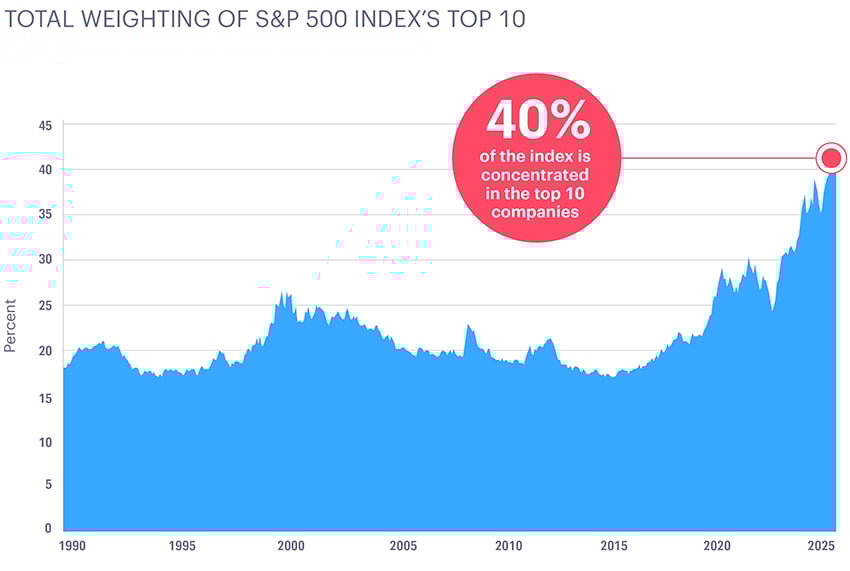
Sources: FactSet and Allspring, as of 31-Dec-25. For illustrative purposes only. The S&P 500 Index consists of 500 stocks chosen for market size, liquidity, and industry group representation. It is a market-value-weighted index with each stock’s weight in the index proportionate to its market value. You cannot invest directly in an index. Past performance is not a reliable indicator of future results.
Expect the unexpected
Our approach to risk management
Transcript
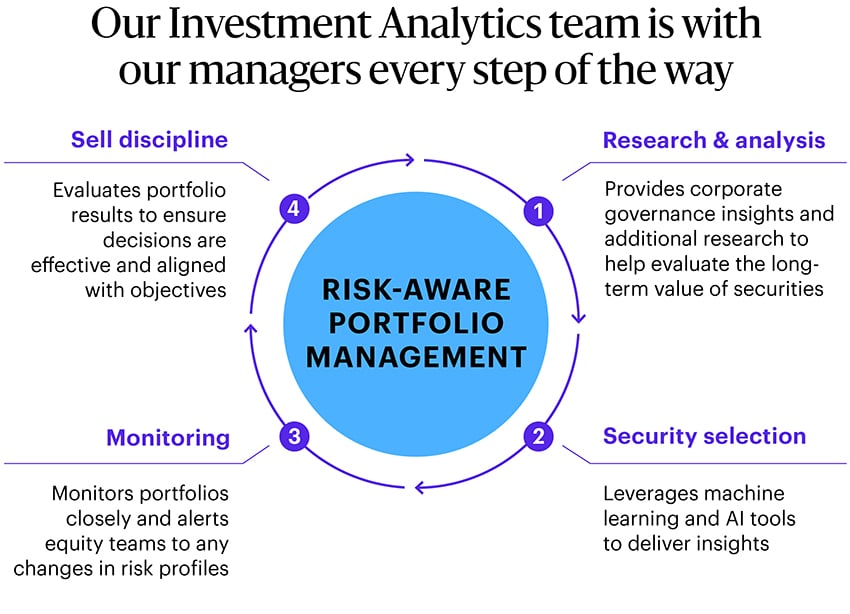
John Campbell: Today's markets are complex, and risk can emerge from many angles. This is why we believe relying on just one perspective isn't enough. For us, evaluating risk means building a complete picture. Without research, it's nearly impossible to understand the risks involved in investing. That's why the Systematic Core team blends our advanced quantitative tools with deep, fundamental analysis to gauge the true picture of investment risk. Starting with the bottom left quadrant, when we apply quantitative risk models from the bottom up, we get a clear view of fundamental risks. These risks are typically referred to as common factor or style risks. We use a research-based model to keep our strategies on track. This helps us control how much our results might differ from the market and avoid risks that don't fit with our investment approach. Why? Because if we take on risks that don't align with our strategy, it can water down performance, create surprises, and make it harder to deliver consistent results. Moving to the top left quadrant, we want to be mindful of macroeconomic forces. Think of this as big-picture stuff that can shake up the market. These are forces we can't control but we need to watch closely—things like interest rates, changes in commodity prices, and global trends in yields. Keeping an eye on these helps us understand how broad economic shifts might impact our investments so we can make smarter decisions in a constantly changing world. Quantitative risk models have been foundational to our team's process since the 1990s, providing what we believe is repeatability and consistency. But we also think that relying on these models alone would leave out half the picture. Numbers don't tell the whole story. Some risks are harder to measure or only matter for a short period of time—things like geopolitical tensions, new technologies shaking up an industry, or sudden policy changes. These emerging risks don't always show up in traditional models, but they can have a big impact on markets. That's why we look beyond the data to identify these trends early and adjust when needed. Qualitative analysis applied from the top down helps us stay ahead of the curve, not just react to it. Finally, we dig deeper at the company level to find idiosyncratic risks—unique challenges like lawsuits, regulatory roadblocks, or negative sentiment. Our portfolio managers go beyond traditional models by tapping into diverse sources—news trends, corporate actions, and even unusual price moves. This bottom-up approach gives us a clearer view of company-specific risks and helps us avoid costly surprises. And now, we see the full picture—a multidimensional approach to risk that allows us to navigate complex markets with greater clarity, precision, and confidence. Our risk management approach guides us in seeking companies we believe offer attractive valuations and strong fundamentals. Through this disciplined process, we strive to build portfolios designed to navigate changing market conditions and align with client objectives.
Surveying risk throughout the process
Featured active ETFs
Featured insights

Neville Javeri is a portfolio manager and head of Allspring’s Empiric LT Equity team. The team incorporates their fundamental company views within a rigorous process, aiming for consistent long-term returns.

Emerging markets (EM) have undergone a structural shift, with stronger external balances, rising credit quality, and broadening earnings growth reshaping their risk profile and investment appeal in 2026.
Michael Bradshaw, senior portfolio manager and head of Precious Metals for Allspring, has deep experience in precious metals—starting in the gold mines of northern Ontario. That adds a real advantage, especially as complexity or risk rises.

John Campbell reviews 2025's market performance, highlights elevated factor risks, and emphasizes a multidimensional approach to risk management and diversification for 2026.

Bryant VanCronkhite highlights the evolving AI landscape, a shift in small-cap market dynamics, and the potential for a massive multi-industry upgrade cycle driving economic and market growth in 2026.

SMID-cap stocks offer a compelling combination of attractive valuations, cyclical and secular tailwinds, and a means to diversify portfolio concentration. Taking an active approach can uncover hidden opportunities, manage risk, and drive long-term growth.

According to Derrick Irwin, senior portfolio manager and co-head of Allspring’s Intrinsic Emerging Markets Equity team, there’s potential for a sea of change in how investors allocate to emerging market equities.

Many portfolio managers think like engineers, but it’s rare to find one with a background in nuclear engineering. John Campbell explains how his team fuses systematic and fundamental models to manage U.S. equities.

The global landscape is shifting, and structural tailwinds are lifting emerging market (EM) equities. Investors capitalizing on these trends could benefit from transformative growth opportunities for years to come.

It is possible that an active trading market for ETF shares will not develop, which may hurt your ability to buy or sell shares, particularly in times of market stress. Shares may trade at a premium or discount to their net asset value (NAV) in the secondary market. These variations may be greater when markets are volatile or subject to unusual conditions. There can be no assurance that active trading markets for the shares will develop or be maintained by market makers or authorized participants. Shares of the ETFs are not redeemable with the ETF other than in creation unit aggregations. Instead, investors must buy or sell the ETF shares in the secondary market at market price (not NAV) through a broker-dealer. In doing so, the investor may incur brokerage commissions and may pay more than NAV when buying and may receive less than NAV when selling. Investing involves risk, including the possible loss of principal. Stock values fluctuate in response to the activities of individual companies and general market and economic conditions. Bond values fluctuate in response to the financial condition of individual issuers, general market and economic conditions, and changes in interest rates. Changes in market conditions and government policies may lead to periods of heightened volatility in the bond market and reduced liquidity for certain bonds held by the fund. In general, when interest rates rise, bond values fall and investors may lose principal value. Interest rate changes and their impact on the fund and its share price can be sudden and unpredictable. High yield securities and junk bonds have a greater risk of default and tend to be more volatile than higher-rated securities with similar maturities. Mortgage- and asset-backed securities may decline in value and become less liquid when defaults on the underlying mortgages or assets occur and may become volatile in periods of rising interest rates. Foreign investments are especially volatile and can rise or fall dramatically due to differences in the political and economic conditions of the host country. These risks are generally intensified in emerging markets. Smaller-company stocks tend to be more volatile and less liquid than those of larger companies. Municipal securities risk includes the ability of the issuer to repay the obligation, the possibility of future tax and legislative changes, and other factors that may adversely affect the liquidity and value of the municipal securities in which the fund invests. A portion of the fund’s income may be subject to federal, state, and/or local income taxes or the alternative minimum tax. Any capital gains distributions may be taxable. Consult the fund’s prospectus for additional information on these and other risks.